Installing a Ceiling Fan With No Junction Box
Fan-rated brace box requirements, attic-access vs no-access install methods, drywall vs plaster patching, weight limits, and add-on cost.
By Michael Chen, Licensed Master Electrician ·
As a Toronto electrical contractor, our team constantly helps property owners figure out the safest way to tackle a ceiling fan installation when there is no existing junction box.
It is an incredibly common upgrade that immediately improves air circulation and room comfort.
Adding a ceiling fan no junction box requires structural support and new wiring, not just pulling a few cables.
We handle this exact scope of work almost every day across the local area.
Let’s look at the actual code requirements, typical costs, and step-by-step methods you need to know before opening up your ceiling.
What This Guide Covers
Before you book any electrical work, you need a quick overview of the exact steps and code rules involved.
This guide breaks down exactly what a proper, safe installation entails.
You will know exactly what to ask your electrician and what to expect on the final invoice.
1. Fan-rated brace box requirement
In a typical Toronto residential project, the work here is straightforward when handled by an ESA-licensed electrician with the right diagnostic gear.
We have handled this scope across the GTA, including Toronto, North York, Scarborough, Etobicoke, Mississauga, Vaughan, and Markham.
The installation steps always follow a consistent, safe pattern.
Specifics heavily depend on your home’s vintage, wall finish, and existing electrical service capacity.
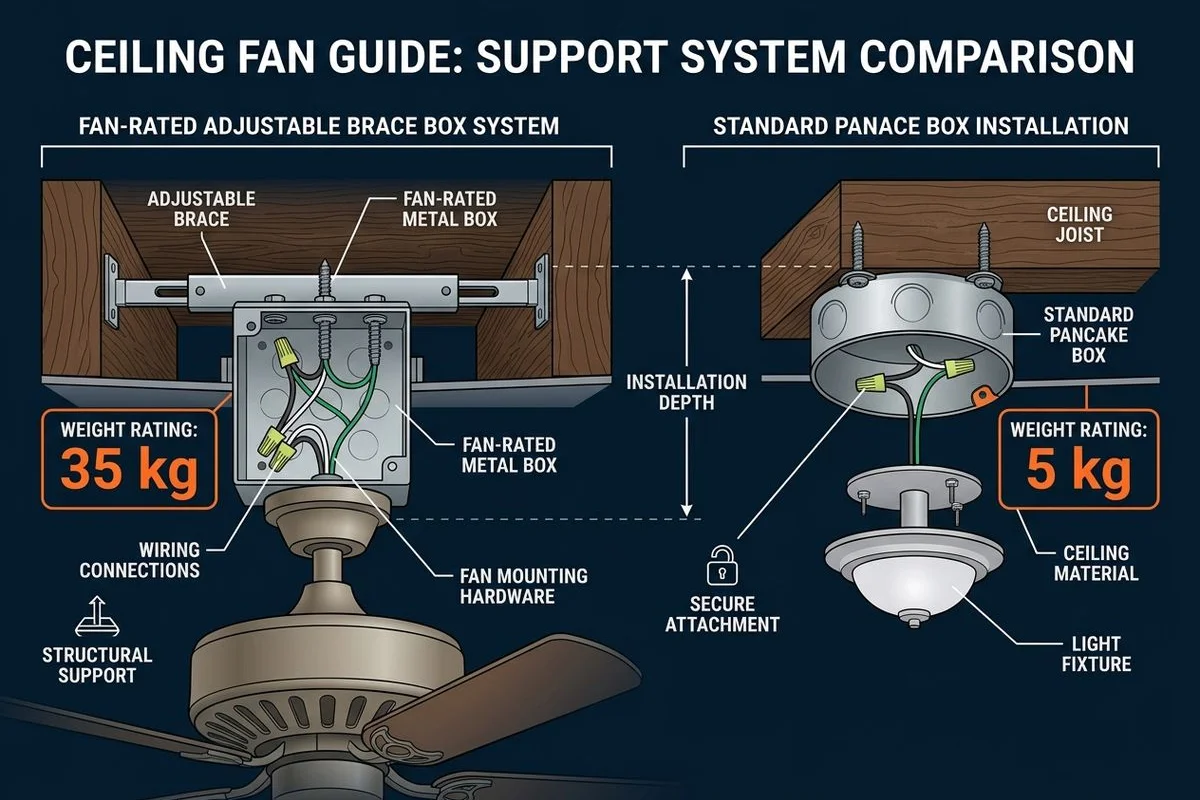
Rule 30-314 of the Ontario Electrical Safety Code clearly states that standard plastic light boxes cannot hold the dynamic weight of a spinning motor.
You need a specialized fan rated brace box designed specifically to handle torque and vibration.
| Feature | Standard Light Box | Fan-Rated Brace Box |
|---|---|---|
| Weight Capacity | Up to 15 lbs | Up to 70 lbs (dynamic) |
| Code Compliant | No | Yes |
| Mounting Style | Fixed to a single joist | Expands tightly between two joists |
2. Attic-access vs no-access install methods
Ceiling access dictates exactly how we route the brand new wiring to your target centre point.
We evaluate your ceiling joist structure carefully before cutting a single hole.
Homes with a clear, walkable attic above the room make it easy to drop cables directly down to the new location.
A no-access install means we must snake cables entirely through finished, enclosed ceilings.
Electricians use specialized flexible drill bits and fiberglass fish tapes to route power from an existing switch without destroying your drywall.
Here is a quick look at how the two routing methods differ:
- Attic Access: Takes significantly less time, requires zero drywall repair, and allows easy cable securing along the attic framing.
- No Access (Between Floors): Requires precise measuring and potential small notch cuts near walls to route power.
- Joist Direction: If your floor joists run perpendicular to the required wire path, expect a longer timeline to drill through each joist safely.
3. Drywall vs plaster patching
The material of your ceiling drastically affects the preparation work and the final finish.
Our team always adjusts cutting methods based on the specific architectural era of your house.
Post-1980s houses usually feature standard 1/2-inch drywall.
Cutting a clean 4-inch circle in drywall for your new box is fast and leaves a perfectly smooth edge for the canopy to cover.
Older Toronto neighbourhoods like Cabbagetown or High Park often feature original lath and plaster ceilings.
These brittle surfaces require extreme care to prevent spiderweb cracking across the entire room.
We use fine-tooth hole saws or oscillating multi-tools to cut through the heavy plaster and wooden lath cleanly without causing structural damage.
4. Weight limits and code
Meeting strict safety codes ensures your new heavy fixture stays securely attached to the framing overhead.
We strictly adhere to the latest 2026 Ontario Electrical Safety Code guidelines for all ceiling support systems.
The code mandates a specialized support system for any fan weighing more than 16 kg (35 lbs).
Even if your preferred model is extremely light, the spinning motion creates dynamic torque that standard plastic boxes simply cannot handle over time.
Always check the exact fan support requirements listed on the manufacturer packaging before purchasing.
Ignoring these local code limits can lead to severe property damage or hidden electrical hazards.
5. Typical add-on cost vs simple swap
Pricing out a brand new installation differs significantly from just swapping out an old fixture on an existing box.
We want to be completely transparent about what actually drives these project numbers.
A simple swap uses existing wiring and an already upgraded, secure ceiling box.
When you add ceiling fan no wiring present, the project involves pulling a new dedicated circuit, adding a wall switch, and installing the heavy-duty brace box.
In the current Toronto market, a standard complete installation typically ranges between $350 and $800 depending on attic access and total wiring distance.
To protect yourself, keep these quoting tips in mind:
- Get the complete quote in writing with a flat-rate number before any work starts.
- Avoid “hourly plus materials” quotes because they almost always drift higher as the day goes on.
- Watch out for “starting at” pricing without context, as this usually escalates fast once the tools come out.
Ready for a Quote?
If you are ready to scope this work properly, we would be happy to talk through your project.
A real Licensed Electrical Contractor evaluating a typical residential job in Toronto, North York, or the wider GTA will give you a fixed price within 24 hours of a site walk.
Our office provides free estimates on residential projects across the region.
Every single job is flat-rate quoted, with all required ESA permits filed directly under our LEC name.
A Certificate of Acceptance is always included to guarantee the final safety of your home.
Visit ceiling fan installation for the full scope of what we do, or contact us directly to get your project started today.
Frequently Asked Questions
What's a fan-rated brace box?
+
An expanding metal brace that mounts between joists and supports the fan's vibrating load. Required by code. For Toronto homes specifically, we handle this through our LEC with the ESA permit included in the flat-rate quote. Free estimates on residential projects.
What if there's no attic access?
+
We work from below with a remodel-style brace. No drywall hole bigger than the fixture itself. For Toronto homes specifically, we handle this through our LEC with the ESA permit included in the flat-rate quote. Free estimates on residential projects.
Why can't I use the existing light fixture box?
+
Standard pancake or octagonal boxes aren't rated for the dynamic load of a fan. For Toronto homes specifically, we handle this through our LEC with the ESA permit included in the flat-rate quote. Free estimates on residential projects.