What Is Aluminum Wiring? (1965–1975 Homes)
Era of installation, expansion/contraction issues, oxidation at terminations, fire risk at outlets/switches, and why copper replaced it.
By Michael Chen, Licensed Master Electrician ·
Owner of a 1960s-70s home, wants a primer before deciding what to do.
What Is Aluminum Wiring? (1965-1975 Homes)
You likely already know that aluminum is a cheaper electrical conductor used heavily in 1965 1975 wiring. If you are asking what is aluminum wiring problem, the main issue is how the metal behaves under stress, expanding and contracting to create loose, dangerous connection points.
We regularly see the aftermath of these degraded circuits in older properties across Toronto as a contractor delivering safe, code-compliant solutions. Data from the U.S. Consumer Product Safety Commission reveals that homes with this vintage wiring are 55 times more likely to reach fire hazard conditions than copper-wired homes.
Upgrading aluminum connections is not just about code compliance; it is the defining factor for keeping your property insured.
Many Ontario insurers flatly refuse coverage renewals without an official safety inspection.
Our licensed electricians secure an Electrical Safety Authority Certificate of Acceptance for every remediation job, ensuring your insurance stays intact. Let’s review the specific failure points of these systems and outline the exact steps required to resolve them.
What This Guide Covers
This guide covers the specific physical failures of an aluminum branch circuit and the standard compliance steps required to fix them. You will learn the exact timeline of these installations, the mechanics of wire degradation, and why modern electrical codes mandate specific repairs.
We approach these upgrades systematically to eliminate guesswork for property owners. The following breakdown details the core vulnerabilities of older wiring.
Understanding these facts makes choosing the right repair strategy much easier.
1. Era of installation (1965-1975 across the GTA)
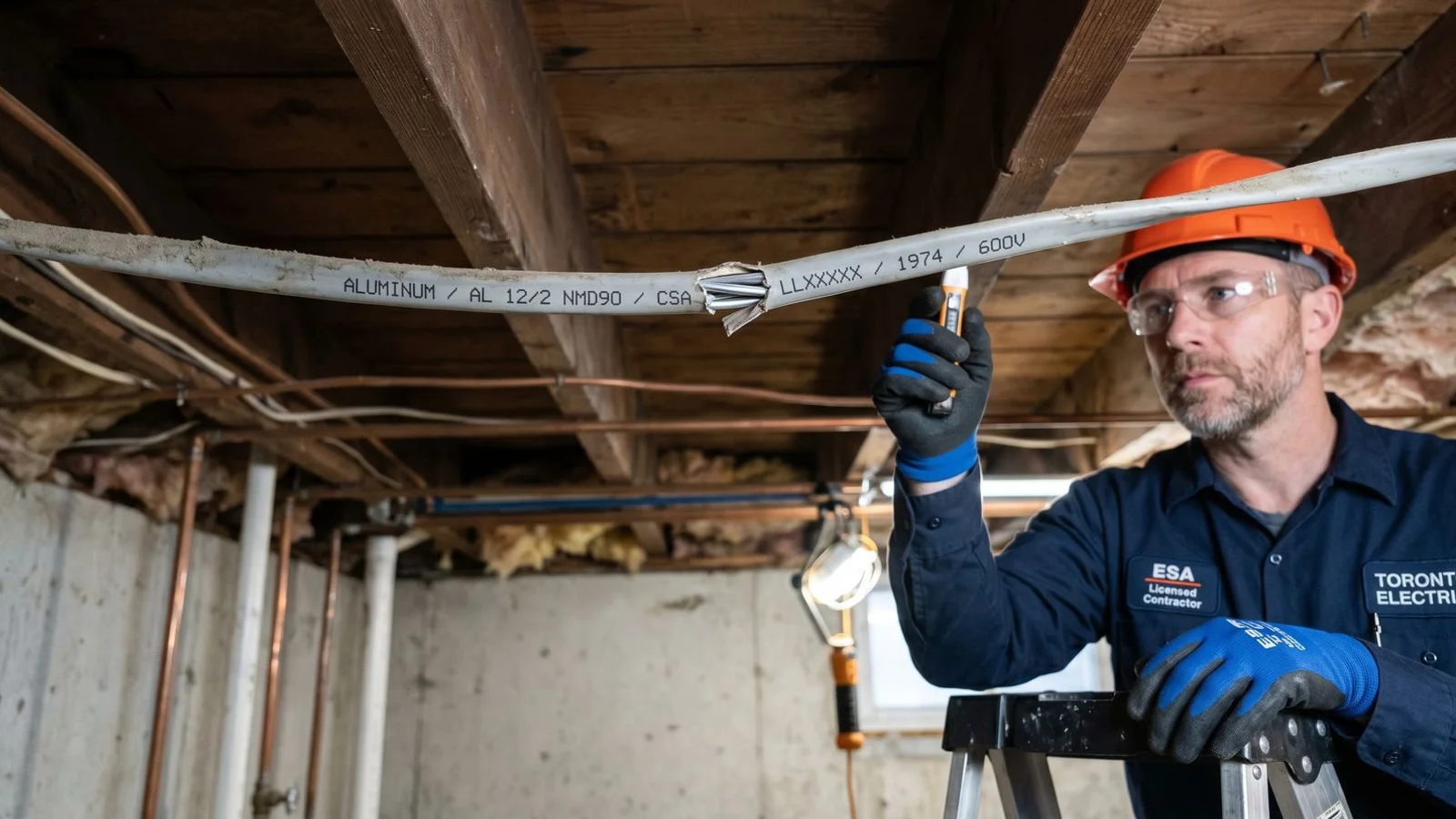
These controversial circuits were installed primarily between 1965 and 1975, when copper prices spiked during global shortages. Builders adopted aluminum as a cost-saving measure for standard 15-amp and 20-amp branch circuits.
We find this specific wiring vintage in hundreds of homes across Toronto, North York, and Mississauga. The Ontario Electrical Safety Code still technically permits this metal, but residential branch circuits under 40 amps require strict, modernized connection methods.
Our diagnostic process immediately flags these older runs for remediation. Property owners must confirm their home’s age to assess the baseline risk level.
| Wiring Material | Cost in 1960s | Common Usage Era | Fire Hazard Risk (CPSC) |
|---|---|---|---|
| Aluminum | Low | 1965 to 1975 | 55x Higher |
| Copper | High | Pre-1965 & Post-1975 | Standard Baseline |
A simple inspection of the basement electrical panel can usually identify the distinct silver-coloured conductors marked with ‘AL’ or ‘Aluminum’.
2. Expansion and contraction at terminations
Aluminum wiring undergoes a dangerous process called ‘cold creep’ because it expands significantly more than copper when heated by electrical current. This constant swelling and shrinking gradually loosens the connections at screws and terminals.
We frequently discover loose terminals that have been quietly degrading for decades. A loose wire creates high electrical resistance, which generates intense heat and eventually sparks a fire.
- Faceplates that feel warm or hot to the touch.
- Flickering lights that occur without a clear external cause.
- Buzzing sounds originating directly from the outlets.
- A faint smell of burning plastic near switches.
The softness of the metal makes the situation worse, as it deforms permanently under the pressure of a tightened screw.
Our licensed electricians use specialized torque screwdrivers to ensure new connections meet exact manufacturer specifications. Regular maintenance cannot reverse the physical deformation of the metal. Upgrading the connection points is the only permanent solution to cold creep.
3. Oxidation issue at outlets and switches
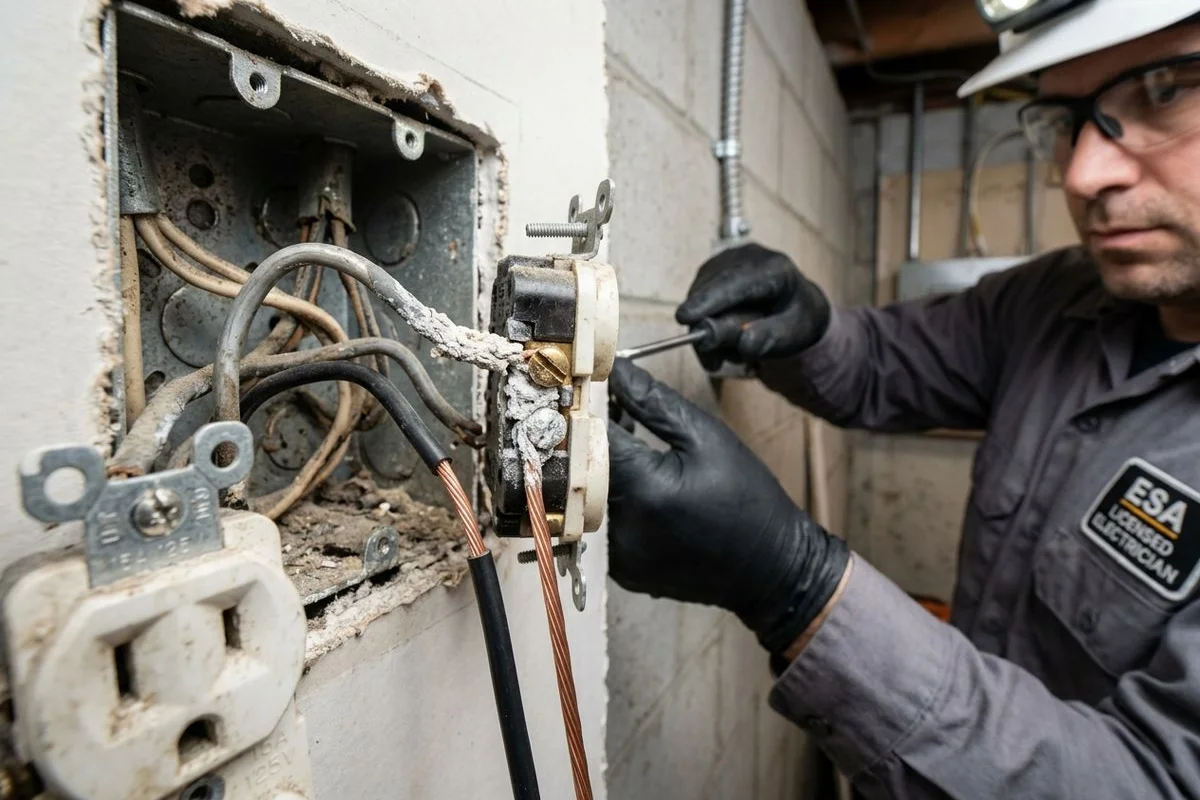
Exposure to oxygen causes the outer surface of an aluminum wire to deteriorate and form a layer of aluminum oxide. Unlike copper oxide which conducts electricity smoothly, aluminum oxide acts as a resistor that severely impedes electrical flow.
We see the scorch marks from this resistance on receptacles throughout the GTA. This resistance generates localized heat that melts plastic wire insulation and ignites surrounding building materials.
Common household devices vulnerable to oxidation include:
- Standard light switches
- Wall receptacles and outlets
- Lighting fixture junction boxes
- Main electrical panel breaker terminals
Moisture in the air accelerates the problem by causing galvanic corrosion when the aluminum touches dissimilar metals like brass.
Our remediation strategy involves applying a specialized oxide-inhibiting compound to every repaired termination. Standard wall outlets are completely unequipped to handle this chemical reaction. Only devices explicitly stamped ‘CO/ALR’ are certified to resist these specific oxidation issues.
4. Fire risk at terminations specifically
The actual fire risk almost never exists within the straight run of the wire itself. The extreme danger is isolated to the termination points where the aluminum connects to outlets, switches, and the main breaker panel.
We always focus our initial safety inspections directly on these high-risk junction boxes. A typical residential property contains over 200 individual wire connections, creating 200 distinct opportunities for a fire to start.
The extreme danger of an aluminum vs copper home setup is rarely the cable behind the drywall; the hazard lies entirely where the metal meets the screw.
If a homeowner previously installed standard copper-only receptacles, the risk of a thermal event skyrockets immediately.
Our crew systematically opens and evaluates every single device box without disturbing the fragile, aged conductors. Approved repair methods include full rewiring or installing specialized copper pigtails using ESA-compliant connectors.
5. Why copper replaced it
Copper regained its status as the industry standard by the late 1970s because it is a vastly superior, safer electrical conductor. The metal possesses higher tensile strength, minimal thermal expansion, and excellent ductility, making it far less prone to breaking or loosening over time.
We exclusively use copper materials for all new branch circuit installations today. Copper wire can easily carry the same electrical load in a smaller diameter than its bulkier aluminum counterpart.
| Property | Copper Conductor | Aluminum Conductor |
|---|---|---|
| Thermal Expansion | Minimal | High (Causes loose connections) |
| Oxidation Effect | Conducts electricity | Resists electricity (Generates heat) |
| Malleability | Stable under pressure | Deforms and flows under screws |
| ESA Status (Residential) | Standard practice | Restricted for small branch circuits |
The modern Ontario Electrical Safety Code heavily restricts aluminum for small residential branch circuits under 40 amps.
Our clients rest easier knowing their upgraded copper pigtails eliminate the inherent chemical flaws of the older metal. Replacing the compromised connection points restores the safety and insurability of the property.
Ready for a Quote?
If you are ready to evaluate the scope of this work, the next step is a professional assessment. We handle all compliance paperwork, ensuring the job is done legally and safely.
The standard repair package includes:
- Free, flat-rate quotes across the GTA
- Official ESA permits filed in our name
- A formal Certificate of Acceptance for your insurer
Our team is standing by to answer any questions you might have about your panel.
Visit aluminum wiring remediation for the full scope of the repair process, or contact us directly to book an inspection.
For more context on related decisions, read our guide on pigtailing vs Full Aluminum Wiring Replacement.
Frequently Asked Questions
Is the wire itself dangerous?
+
The run isn't. The terminations are; pigtailing addresses every termination with copper-aluminum-rated devices. For Toronto homes specifically, we handle this through our LEC with the ESA permit included in the flat-rate quote. Free estimates on residential projects.
What years had aluminum wiring in the GTA?
+
Roughly 1965–1975, peaking around 1969–1972. For Toronto homes specifically, we handle this through our LEC with the ESA permit included in the flat-rate quote. Free estimates on residential projects.
Can I just replace the outlets?
+
Only with CO/ALR-rated devices and proper torque. And pigtailing with AlumiConn is the more reliable approach. For Toronto homes specifically, we handle this through our LEC with the ESA permit included in the flat-rate quote. Free estimates on residential projects.