Commercial LED Lighting Retrofit (Toronto)
Audit step, fixture-vs-lamp swap decision, ballast-bypass options, payback estimation, and available Save on Energy programs.
By Michael Chen, Licensed Master Electrician ·
Commercial LED Lighting Retrofit (Toronto)
We know the math on upgrading your facility’s illumination is changing quickly this year. Rising electricity rates across Ontario are forcing property managers to find immediate cost reductions.
Our Toronto electrical contractor team delivers safe, code-compliant upgrades and sees a massive shift toward aggressive energy reductions right now.
You need reliable data to make the right call for your business. We have compiled this guide to highlight the exact steps and current financial incentives available for local projects.
The numbers show that holding off on a commercial LED lighting retrofit in Toronto is actually costing you money. Let’s look at the baseline facts and explore a few practical ways to respond.
What This Guide Covers
This section provides a quick overview of the points worth knowing before you book any work.
1. Audit step (fixture inventory, kWh use baseline)
We start every project with a comprehensive site audit to map out your existing fixture wattage and operating hours. Accurate load calculations are mandatory for meeting ESA (Electrical Safety Authority) requirements in Ontario.
Our certified electricians use advanced diagnostic gear to evaluate the existing service capacity of your building. A proper baseline is the only way to calculate your precise kilowatt-hour (kWh) reduction.
We have handled this scope across the GTA, including Toronto, North York, Scarborough, Etobicoke, Mississauga, Vaughan, and Markham. The audit phase generally evaluates three critical factors:
- Existing fixture wattage and ballast conditions
- Daily operating hours for different building zones
- Verification of 347V commercial circuits versus standard 120V setups
Our team relies on this data to accurately predict your future energy bills. Skipping this exact inventory often leads to rejected rebate applications later on.
2. Fixture-vs-lamp swap decision
We help clients choose between replacing the entire fixture or simply swapping the existing lamps for LED tubes. A full commercial led upgrade replaces the old housing with a modern integrated unit.
Our data shows that high-efficiency LED retrofit kits now draw just 33 watts compared to older 55-watt fluorescent setups. This drastic reduction translates to lower cooling costs during the summer months.
We often recommend full fixture replacements for older buildings where the original housings are cracked or yellowed. Here is a quick comparison to help you decide:
| Option | Upfront Cost | Expected Lifespan | Best Application |
|---|---|---|---|
| Lamp Swap (Tubes) | Lower | 35,000 to 50,000 hours | Newer fixtures in good condition |
| Full Fixture Retrofit | Higher | 100,000+ hours | Old housings or high-bay warehouses |
Our crews install both options depending on your specific budget and aesthetic goals. Upgrading the entire unit provides a cleaner look and eliminates the maintenance of aging sockets.
3. Ballast-bypass and direct-wire options
We strongly prefer the Type B ballast-bypass method for commercial lighting retrofit projects. This approach completely removes the old fluorescent ballast and wires the new LED directly to the line voltage.
Our electricians frequently encounter 347V circuits in Canadian commercial spaces. Bypassing the ballast eliminates the most common point of failure in overhead lighting systems.
We advise against “plug-and-play” Type A tubes because they still rely on the aging ballast to function. When that old component inevitably dies, the new bulb will stop working entirely.
Our installation process ensures your facility meets all current safety codes. A recent industry analysis from ELEDLights highlights a major financial benefit to this approach:
“Bypassing the ballast eliminates a major failure point, potentially saving a mid-sized facility over $1,140 annually in lift rentals and maintenance labour.”
We always secure the necessary permits to perform this direct-wire work legally. Proper documentation guarantees that your insurance policy remains valid after the upgrade.
4. Payback estimation
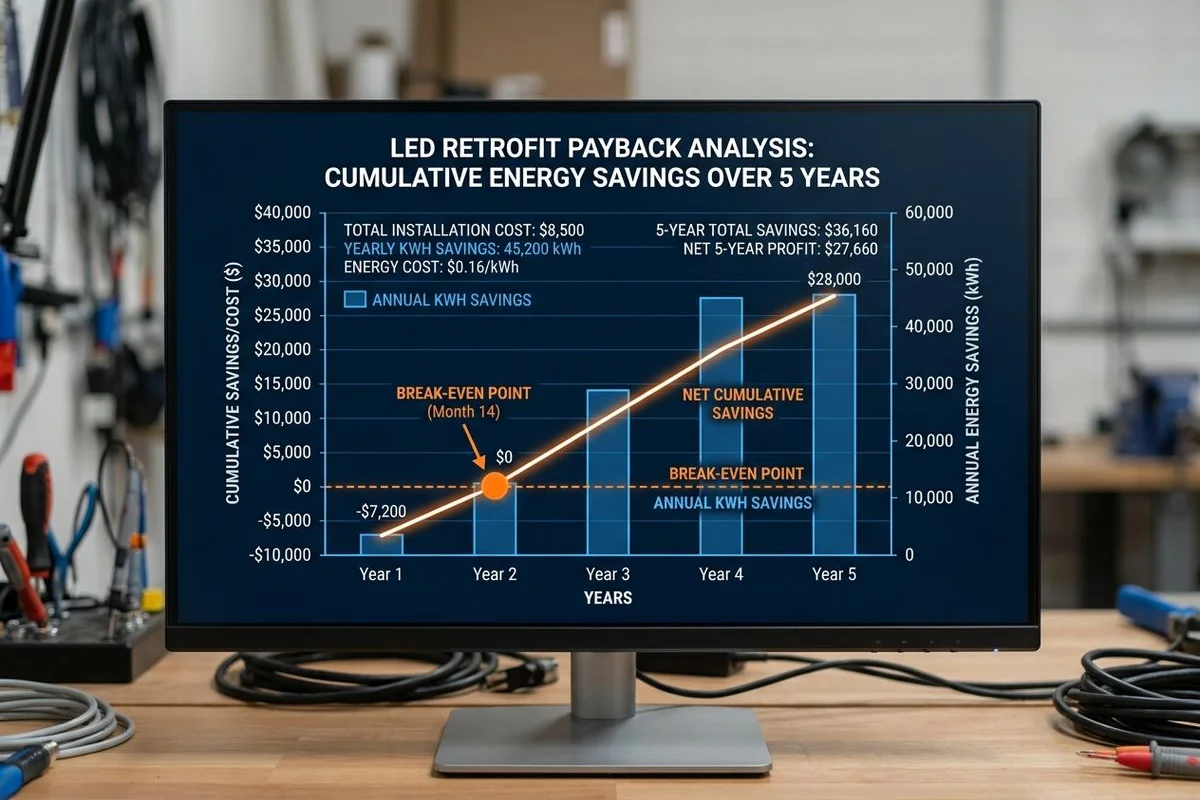
We calculate your commercial lighting payback period by comparing the installation cost against your projected energy savings. Most commercial building owners see a full return on their investment within 1.5 to 3.5 years.
Our recent 2026 project models show that upgrading from 400W metal halide lamps to LEDs achieves the fastest returns. High-burn facilities like 24/7 warehouses routinely hit a sub-2-year payback window.
We factor in local utility rates and demand charges to make these models incredibly accurate. The final calculation includes three main financial drivers:
- Monthly kilowatt-hour (kWh) consumption reductions
- Elimination of routine bulb and ballast replacement costs
- Avoided scissor lift rental fees for high-bay maintenance
Our financial proposals present these numbers clearly so your management team can make a quick decision. A fast ROI makes these upgrades very easy to approve during annual budget reviews.
5. Save on Energy commercial programs
We manage the paperwork to secure your led retrofit save on energy incentives through the Independent Electricity System Operator (IESO). The 2026 provincial guidelines offer several distinct pathways to lower your upfront costs.
Our team heavily utilizes the Instant Discounts Program to get you point-of-sale reductions right on the invoice. This streamlined option covers common upgrades like LED tubes, troffers, and high-bay warehouse fixtures.
We also guide smaller clients toward specific provincial tiers for maximum financial support. Here is a breakdown of the current incentive structures:
| Program Name | Best For | Incentive Amount |
|---|---|---|
| Instant Discounts | Standard replacements | Point-of-sale invoice reduction |
| Small Business Program | Under 50 employees | Up to $3,000 in direct support |
| Custom Retrofit Track | Large industrial facilities | Up to $1,800 per kW saved |
Our experts coordinate these applications to ensure you receive the highest possible payout. Leveraging these utility incentives is the smartest way to fund your facility modernization.
Ready for a Quote?
We are fully prepared to scope this work and discuss your specific building requirements. If you are ready for a free estimate on a commercial LED lighting retrofit in Toronto or other residential projects across the GTA, our pricing is always flat-rate quoted.
Our licensed electricians pull all necessary ESA permits under our specific LEC name. A final Certificate of Acceptance is always included to guarantee code compliance.
We invite you to visit our commercial electrical page for the full scope of what we do.
You can also contact us directly to schedule an on-site consultation.
For more context on related decisions, read our guide on preventative Maintenance Contracts for Commercial Electrical.
Frequently Asked Questions
What's the typical payback?
+
2–5 years depending on operating hours and rate structure. For Toronto homes specifically, we handle this through our LEC with the ESA permit included in the flat-rate quote. Free estimates on residential projects.
Should we replace fixtures or just swap lamps?
+
Lamp swap is faster and cheaper; fixture replacement gives better long-term efficiency and aesthetics. For Toronto homes specifically, we handle this through our LEC with the ESA permit included in the flat-rate quote. Free estimates on residential projects.
Are rebates available?
+
Save on Energy programs come and go. Check current intake; we factor in active rebates on the quote. For Toronto homes specifically, we handle this through our LEC with the ESA permit included in the flat-rate quote. Free estimates on residential projects.