Signs You Need an Electrician (and What You Can DIY)
Warm outlets, flickering lights, frequent breaker trips. When to stop and call. Plus the small jobs Ontario homeowners can legally DIY.
By Michael Chen, Licensed Master Electrician ·
We regularly speak with property owners who spot a strange electrical symptom and wonder if a professional visit is necessary.
The difference between a minor quirk and a serious fire hazard is not always obvious. Our team relies on clear symptoms to determine when to act immediately. A warm outlet or a sudden burning smell usually signals a failing connection that requires urgent intervention.
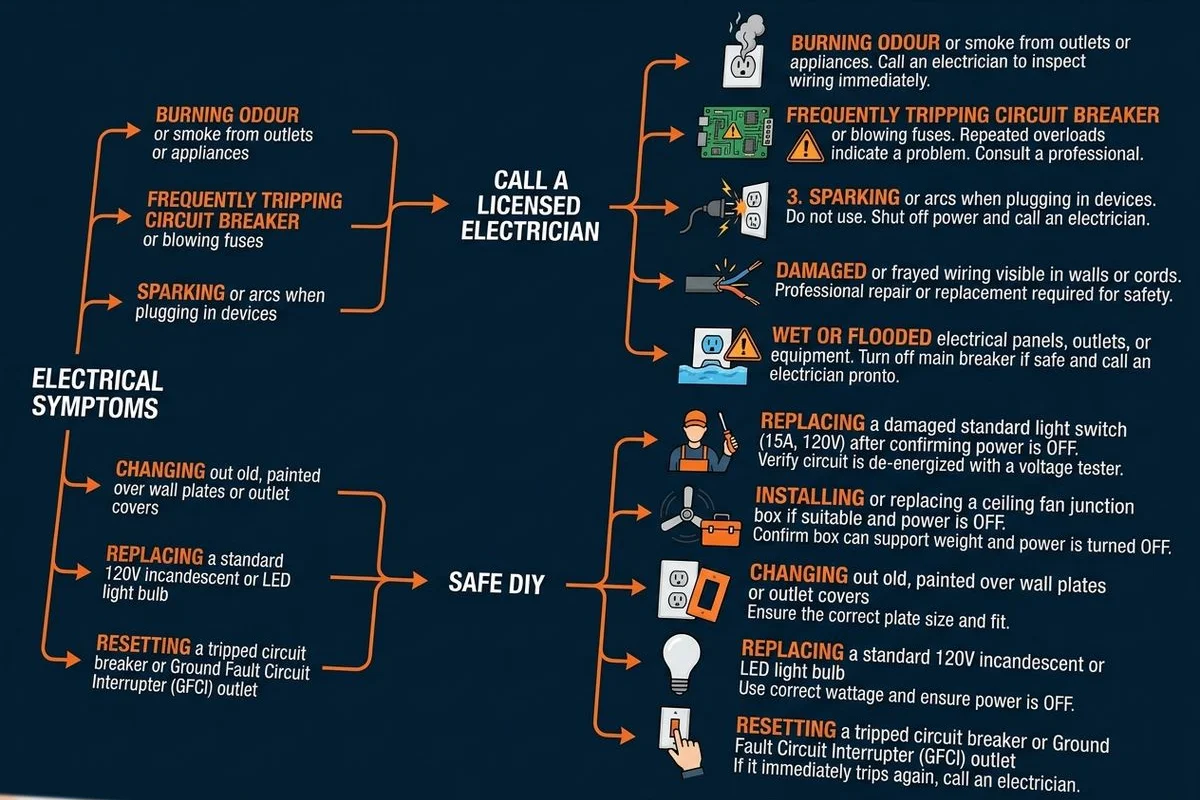
We will break down exactly which warning signs need a licensed expert and which simple tasks you can legally handle yourself. Let’s look at the current Ontario electrical safety requirements, explore practical DIY boundaries, and clarify exactly when to call an electrician.
What This Guide Covers
1. Warning signs that always need a licensed electrician (warm outlet, burning smell, frequent trips, flickering)
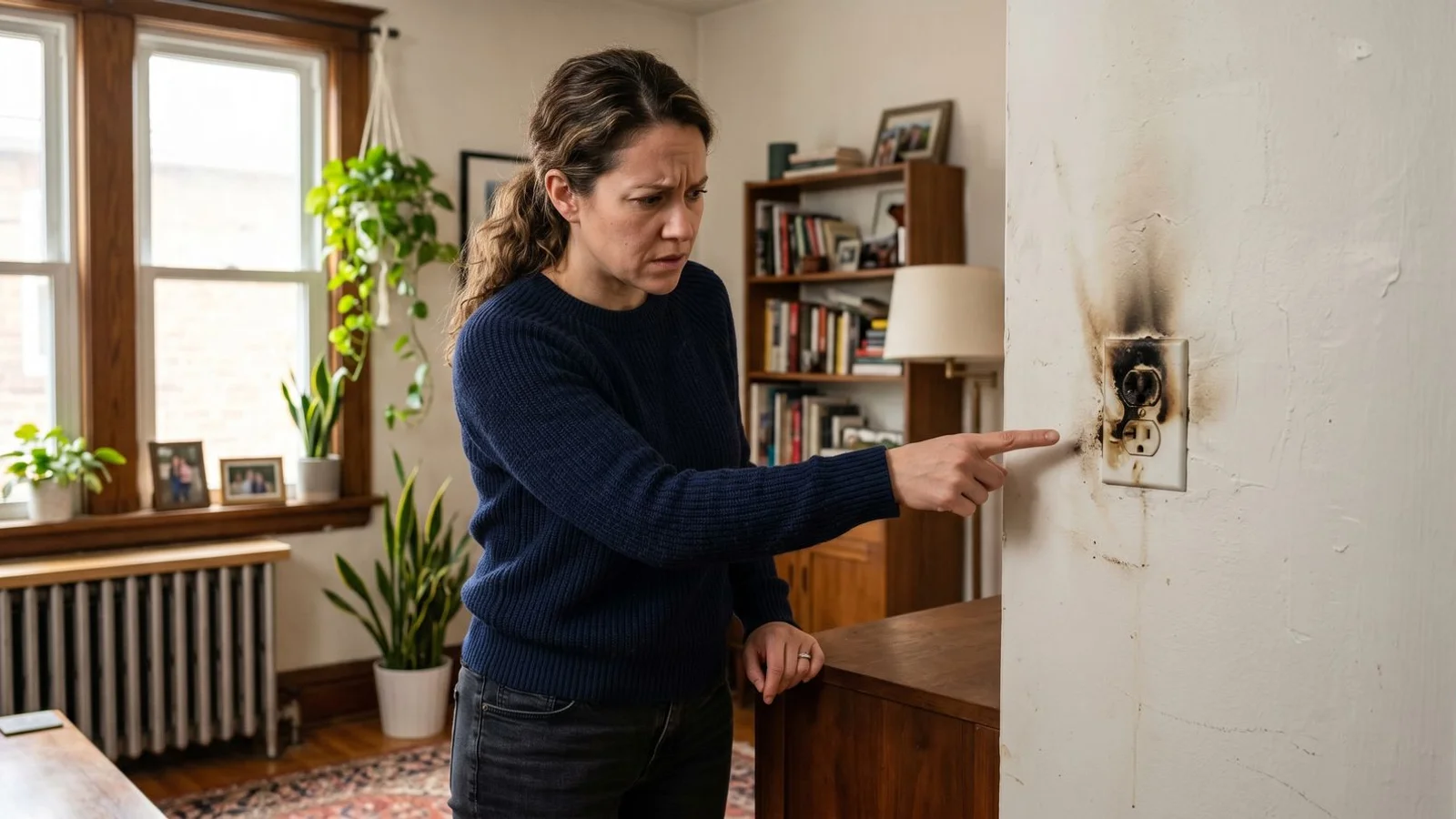
If an outlet feels warm to the touch, you are facing a significant fire risk. Heat indicates electrical resistance, which usually means the wiring has come loose behind the wall.
Our licensed electricians frequently trace these warm outlet warnings back to failing receptacles that no longer meet the strict standards of the Ontario Electrical Safety Code. This code requires perfectly tight, secure connections to prevent dangerous arcing. We always recommend cutting power to that specific room immediately if you feel any heat.
Flickering lights cause a different type of serious concern. A quick dimming effect when a large appliance starts is normal, but sustained flickering often points to a damaged or loose neutral wire.
Our diagnostic tools sometimes show extreme voltage swings during a lost neutral event. One side of your electrical system might drop to 53 volts while the other surges to nearly 187 volts. We see this severe imbalance destroy expensive televisions and sensitive kitchen appliances in seconds.
You should stop using the affected circuits and call a professional if you notice any of these symptoms:
- A persistent fishy or burning plastic smell near switches.
- Crackling or buzzing sounds coming directly from your main panel.
- Circuit breakers that trip repeatedly after being reset.
- Mild shocks or tingles when touching an appliance.
Our team handles these urgent diagnostics across the Greater Toronto Area daily. Quick action prevents minor component failures from becoming major house fires.
2. Signs that look scary but are usually harmless
Sometimes a symptom appears alarming but actually has a benign explanation. Modern electrical systems manage heavy loads, and minor fluctuations are part of standard operation. Our technicians often arrive at homes to find that the electrical panel is working exactly as designed.
You can often resolve these common false alarms yourself:
- Momentary dimming: A fraction-of-a-second voltage drop when a heavy appliance starts is perfectly normal.
- Fast-burning bulbs: Before suspecting bad wiring, check if you are exceeding the fixture’s maximum wattage or using cheap incandescent bulbs.
- Single dead wet-room outlet: A tripped Ground Fault Circuit Interrupter button is usually the culprit in kitchens and bathrooms.
Our system checks confirm that large appliances pull a heavy surge of amperage, which causes that momentary light dimming. The brief voltage drop makes the lights dim slightly, which is completely normal. We only worry if the lights stay dim for several seconds or fail to return to full brightness.
Lightbulbs burning out quickly can also mimic a bigger problem. A homeowner might assume their wiring is faulty when a bathroom vanity burns through three bulbs in a month.
Our experience shows that this is frequently caused by using low-quality bulbs or exceeding the fixture limits. You can usually resolve this by upgrading to reputable LED bulbs and ensuring they match the fixture’s specifications.
3. Legitimate DIY scope in Ontario (fixture swaps, simple plug changes)
You might be tempted to tackle a few wiring projects yourself to save money. The rules for electrical DIY Ontario projects technically allow homeowners to perform work within their own primary residence.
Our licensing ensures safety, but you have the legal right to change simple fixtures or swap out a basic switch. A simple plug-and-play replacement is easily handled by a confident DIYer. We encourage property owners to handle basic cosmetic updates if they feel entirely comfortable.
That being said, performing your own electrical work still requires regulatory oversight. The Electrical Safety Authority requires a Notification of Work permit for almost everything beyond swapping a basic fixture.
Here is a quick look at what you can reasonably handle yourself:
- Replacing a standard light fixture with a new one of the same weight and type.
- Swapping a standard white wall receptacle for a new decorative cover.
- Changing a single-pole light switch.
Our administrative staff processes ESA permits daily, but homeowners can file them directly through the authority’s website. A typical residential permit for small upgrades will cost around $100 to $300. We always remind clients that pulling a permit creates a permanent, legal record of the work.
Your insurance company may ask for proof that any self-performed work is safe. An ESA inspector must visit your home to review your DIY wiring and issue a Certificate of Acceptance.
Our team has seen many home sales delayed because previous owners skipped this vital inspection step. You should always complete this final step to protect your home’s resale value.
4. Code-required licensed work (anything inside the panel, new circuits, hardwiring)
Certain projects carry too much risk and complexity for a weekend project. Any work that involves your main service panel, installing new circuits, or running fresh wire must be handled by an expert.
Our Licensed Electrical Contractors hold the specific ECRA/ESA licensing required to execute this work safely. You risk severe shock, fire hazards, and voided insurance policies if you attempt these major changes alone.
The 2026 Ontario Electrical Safety Code introduced strict new standards that professionals must follow. For example, Arc-Fault Circuit Interrupter breakers are now mandatory for nearly all 15A and 20A dwelling circuits, including living rooms and hallways.
Here is a breakdown of tasks that strictly require a licensed professional:
| Task Category | Why It Requires a Pro | Safety Code Standard |
|---|---|---|
| Panel Upgrades | Involves live main utility lines and complex load balancing. | Must meet current OESC service capacity limits. |
| New Circuits | Requires calculating load drops and installing proper breakers. | 2026 Code mandates AFCI on most 15A/20A lines. |
| EV Chargers | Continuous heavy current draw creates severe fire risks if sized wrong. | Dedicated circuitry and load management required. |
| Hardwired Alarms | Life-safety devices must be interconnected flawlessly. | Required on all floors and inside bedrooms. |
Our crews ensure every new installation meets these updated AFCI requirements to prevent hidden electrical fires. A simple wire splice done incorrectly can easily fail modern safety tests.
Many older Toronto homes still operate on outdated 60A or 100A services. A full 100A to 200A upgrade requires a coordinated effort with the city to safely disconnect the main power.
Our standard panel upgrade in Toronto runs between $1,800 and $3,500, which includes the ESA permit and the final inspection. This comprehensive pricing guarantees the work passes all provincial safety checks. We always secure the Certificate of Acceptance in our name for these complex jobs.
5. Decision tree: when to cut power at the panel before calling
Recognizing when to immediately shut off your main power can save your property from disaster. You should never wait for an electrician to arrive if an active electrical fault is generating heat or smoke.
Our emergency dispatchers always instruct callers to isolate the power at the main breaker if they suspect an active hazard. A dead circuit is infinitely safer than a melting wire.
Some specific vintage components require immediate and permanent disconnection. Federal Pacific Stab-Lok and Zinsco panels, common in houses built between the 1960s and 1980s, are documented fire hazards.
You must flip your main breaker to the “off” position if you observe:
- Visible sparks or arcing coming from any wall outlet.
- A localized burning smell near the breaker box itself.
- Water leaking directly into or near your electrical panel.
- Multiple connected appliances turning on and off erratically.
Our technicians regularly remove these old panels because their internal breakers notoriously fail to trip during an overload. The ESA and most major insurance companies refuse to cover homes with these outdated panels due to their high failure rate.
We strongly advise shutting off power to any specific circuit on these panels that acts erratically. You can confidently wait for professional help once the electricity stops flowing.
Talk to an ESA-Licensed Electrician
If you are working through any of these issues and want a second opinion, reach out. We provide free estimates on residential projects across Toronto, North York, Scarborough, Etobicoke, and the broader GTA. Every job is flat-rate quoted to eliminate surprises.
Our team handles all ESA permits in our name, and a Certificate of Acceptance is always included. Contact us today to secure your electrical system.
Frequently Asked Questions
Is a warm outlet always an emergency?
+
Anything more than slightly-warm-to-touch should be powered off at the breaker and inspected. It's a leading indicator of failing wiring. For Toronto homes specifically, we handle this through our LEC with the ESA permit included in the flat-rate quote. Free estimates on residential projects.
Can I replace a light fixture myself in Ontario?
+
Yes for like-for-like fixture replacement on an existing circuit, with power off. But new wiring or relocations need a licensed electrician. For Toronto homes specifically, we handle this through our LEC with the ESA permit included in the flat-rate quote. Free estimates on residential projects.
Are flickering lights serious?
+
Sometimes. Bulb-only flicker is harmless; whole-house flicker often signals a loose neutral or service issue and needs urgent investigation. For Toronto homes specifically, we handle this through our LEC with the ESA permit included in the flat-rate quote. Free estimates on residential projects.