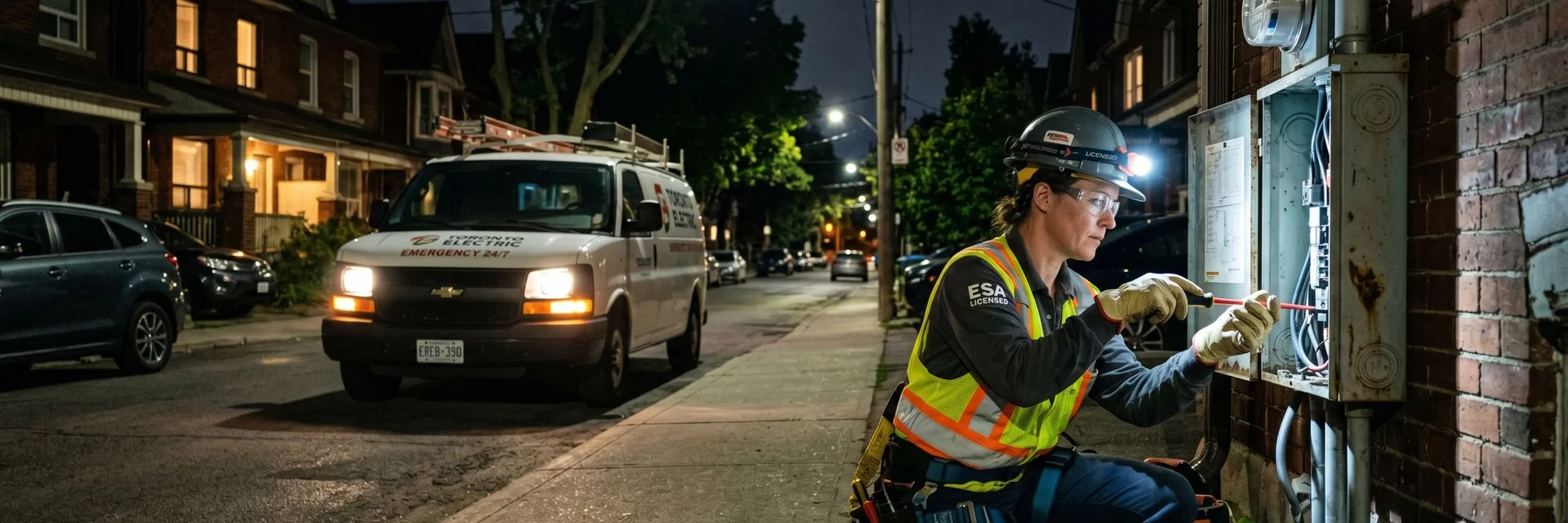
Signs Your Toronto Home Needs a Panel Upgrade
Frequent breaker trips, panel age, Federal Pacific or Zinsco identification, fuse box presence, and EV/heat-pump triggers.
By Michael Chen, Licensed Master Electrician ·
Homeowner self-diagnosing, wants to know if the panel is the cause of recent issues.
Signs Your Toronto Home Needs a Panel Upgrade
You know how frustrating it is when a seemingly normal evening is interrupted by a sudden power loss in half the house.
Many property owners assume a quick reset solves the problem. The truth is often buried much deeper in the electrical system.
We are a Toronto electrical contractor focused on delivering safe, code-compliant work, and our crews constantly see older homes struggling to handle modern appliances. From an engineering perspective, an outdated electrical distribution setup is a massive liability. In Canada, about 20 percent of residential fires start with faulty wiring and electrical distribution issues.
It is an alarming statistic that most people ignore until they smell burning plastic.
So, let’s look at the data and explore the top five signs you need a panel upgrade. Our team will break down exactly what these symptoms mean and how to properly respond.
What This Guide Covers
Quick overview of the points worth knowing before you book any work:
1. Frequent or unexplained breaker trips
Nuisance trips often indicate overloaded circuits, ground faults, or a failing breaker mechanism. Persistent tripping means heat is building up at the connections. This heat degrades the terminals and creates a severe fire hazard.
Our crews use specialized testing equipment to find the root cause of these recurring faults. Finding the exact issue with an old panel Toronto properties rely on requires more than just resetting the switch. We have handled this scope across the GTA, including Toronto, North York, Scarborough, Etobicoke, Mississauga, Vaughan, and Markham.
The steps follow a consistent pattern. Specifics depend on the home’s vintage, wall finish, and existing service capacity.
In a typical Toronto residential project, the work here is straightforward when handled by an ESA-licensed electrician with the right diagnostic gear. A simple circuit redistribution or adding a dedicated appliance line often resolves the overload.
- Overloaded Circuits: Modern appliances draw more current than older lines were built to handle.
- Ground Faults: Moisture or degraded wire insulation causes electricity to take an unintended path.
- Failing Mechanisms: Old breakers lose their calibration and trip prematurely or fail to trip at all.
2. Panel age 40+ years
Panel age Toronto guidelines suggest a standard electrical service board has an expected lifespan of 20 to 25 years. Running a system well past the 40-year mark means it operates completely outside its intended capacity. The 2024 Ontario Electrical Safety Code, effective May 2025, mandates strict modern safety features that older setups lack entirely.
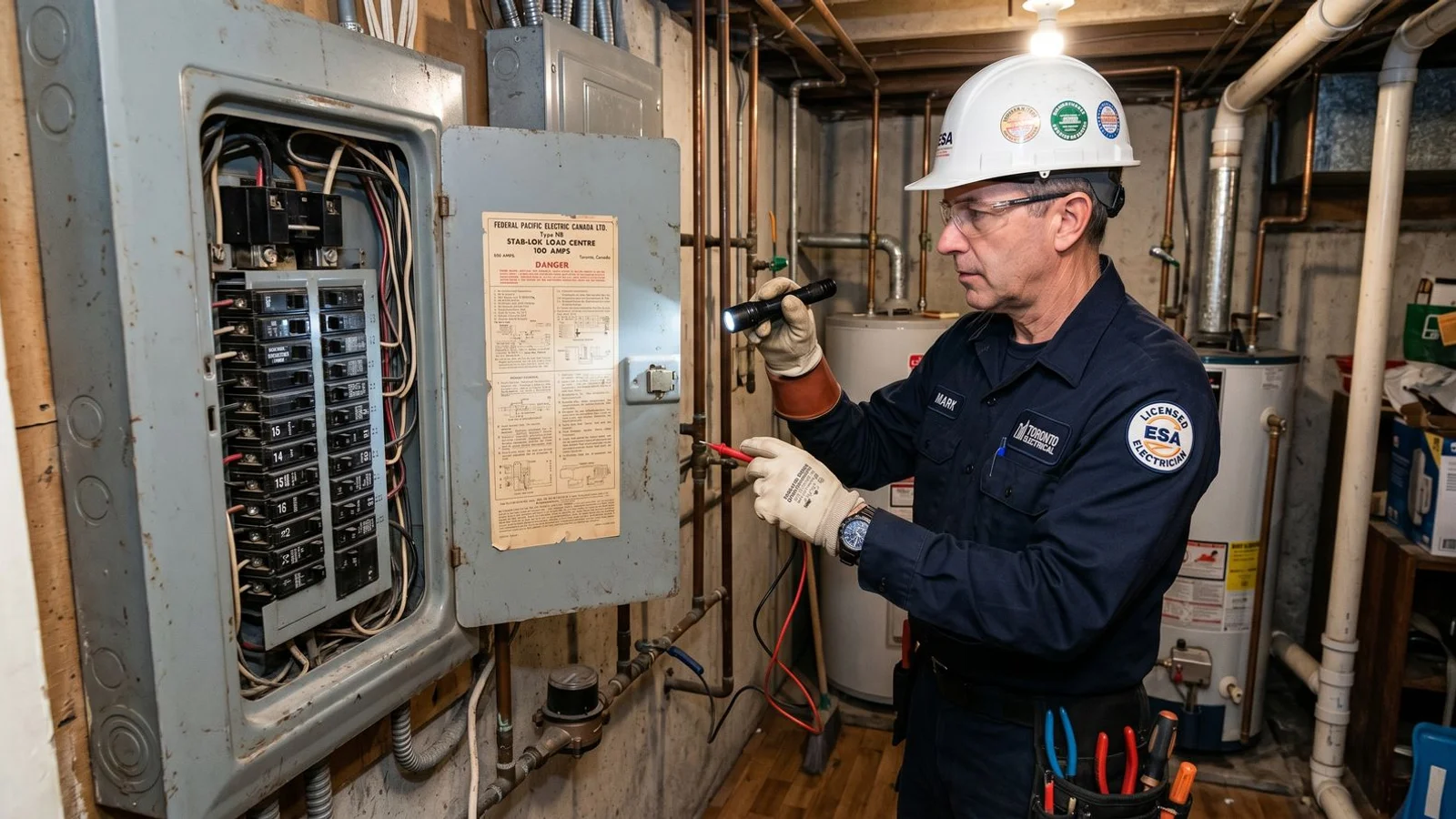
Toronto homes built before the 1990s typically run on 60A or 100A service. Federal Pacific Stab-Lok and Zinsco panels are common in 1960s to 1980s housing. Both are flagged as fire risks by the ESA and most insurers.
Our load calculation process determines exactly what size upgrade your property requires. A 100A to 200A upgrade in Toronto runs $1,800 to $3,500, including the ESA permit, Toronto Hydro disconnect coordination, and final inspection. Sometimes, a 100A service is still adequate if you manage the loads properly.
| Feature | 40+ Year Old System | Modern 2026 Code Compliant System |
|---|---|---|
| Failure Rate | Can easily exceed industry standards | Less than 1% |
| AFCI Protection | None | Required on living space circuits |
| Lifespan Stage | Critically overdue for replacement | Beginning a new 25-year cycle |
3. Federal Pacific Stab-Lok and Zinsco identification (with photos)
Identifying a dangerous electrical board is your first line of defence. Federal Pacific Stab-Lok panels are notorious for a severe design flaw. Independent testing shows up to 80 percent of Stab-Lok breakers fail to trip under critical overload conditions.
Zinsco panels have a different but equally dangerous failure mode. The breakers in a Zinsco setup often overheat and melt directly into the bus bar. This leaves the circuit entirely unprotected and prone to ignition.
Both brands have documented failure modes where breakers do not trip during faults. Most Ontario insurers flag them on inspection and refuse coverage.
We carry replacement panels and breakers in stock. Replacement is the only ESA-acceptable remediation. A typical swap is a single-day project.
- Brand Names: Look for the words Federal Pacific Electric, Federal Pioneer, or Zinsco printed on the door.
- Breaker Colours: Stab-Lok breakers frequently feature bright red, blue, or orange handle tips.
- Manufacturing Dates: These were heavily installed in Toronto homes constructed between the 1960s and the late 1980s.
- Physical Damage: Visible scorch marks or a melted appearance around the bus bar confirm a critical failure.
4. Fuse box presence (any fuse panel = upgrade candidate)
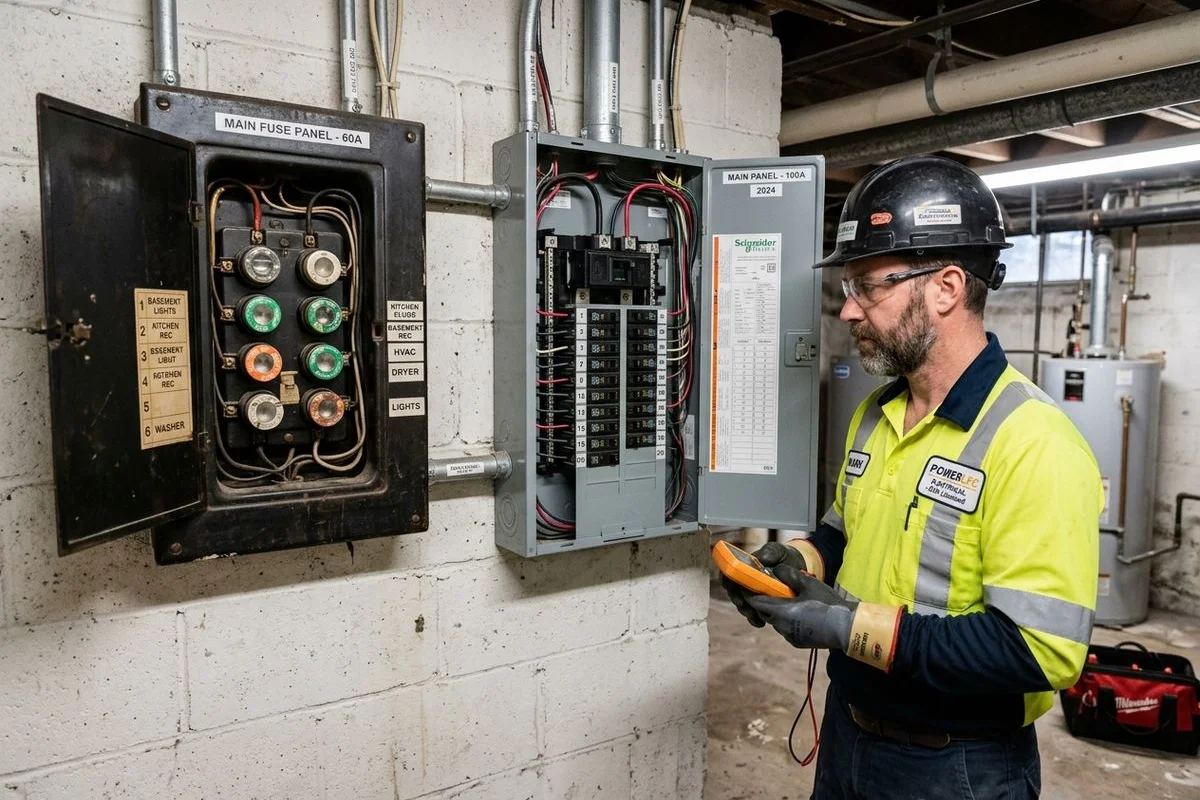
Neighbourhoods like the Annex, Cabbagetown, and the Beaches are full of properties still relying on old technology. Toronto homes built before the 1990s typically run on 60A or 100A service. A 60-amp fuse setup was standard for the post-war building boom, but it simply cannot handle today’s demand.
The real danger with fuses is human error and modification. Homeowners frequently replace a blown 15-amp fuse with a 20-amp or 30-amp version. This forces the thin wiring to carry unsafe current levels, causing extreme heat and potential wall fires.
Our team consistently sees insurance companies mandate costly upgrades for these properties. Just like the Federal Pacific Stab-Lok and Zinsco panels common in 1960s to 1980s housing, any fuse panel is flagged as a fire risk by the ESA and most insurers.
Moving away from this outdated technology through a proper fuse box replacement requires professional intervention. A 100A to 200A upgrade in Toronto runs $1,800 to $3,500, including the ESA permit, Toronto Hydro disconnect coordination, and final inspection. Upgrading directly to a modern breaker system often pays for itself quickly through lower home insurance premiums.
“Oversizing fuses is a leading cause of electrical fires in older Toronto properties. A 15-amp wire protected by a 30-amp fuse has zero effective overcurrent protection.”
5. Plans for EV / heat pump / basement suite
Adding significant electrical loads changes the entire equation for your property. A modern Level 2 electric vehicle charger pulls between 24 and 42 amps of continuous current. A standard 100A service panel will struggle under this massive load, causing flickering lights and localized outages.
We supply Tesla Wall Connector, ChargePoint Home Flex, Grizzl-E, and Wallbox units. A standard Level 2 EV charger installation in Toronto runs $800 to $1,500 typical, including the ESA permit. High-demand appliances like heat pumps and induction stoves require similar capacity planning.
Toronto condo installs frequently require DCC-9 or DCC-11 load management devices to safely share power without exceeding the main feed. Our electrical experts handle the condo-board approval workflow as part of the install. Proper load management allows you to add modern amenities even if a full panel expansion is impossible.
- Level 2 EV Chargers: Require a dedicated 240V circuit and up to 50 amps of space.
- Air Source Heat Pumps: Need substantial continuous power for efficient winter heating.
- Basement Suites: Adding a second kitchen means heavy loads from a separate stove and refrigerator.
- Induction Ranges: Draw intense, rapid bursts of energy that older boards cannot distribute smoothly.
Ready for a Quote?
If you are ready to scope this work, our team is happy to talk. We do free estimates on residential projects across the GTA.
Every project is flat-rate quoted. Your required ESA permits are always filed under our LEC name. A final Certificate of Acceptance is always included with our work.
Visit electrical panel upgrade for the full scope of what we do. You can also contact us directly to book your assessment today.
For more context on related decisions, read our guide on what Is an Electrical Panel Upgrade and When Do You Need One?.
Frequently Asked Questions
How can I tell if I have a Federal Pacific panel?
+
Look for the 'FPE' or 'Stab-Lok' label on the panel door; we can confirm in a free assessment. For Toronto homes specifically, we handle this through our LEC with the ESA permit included in the flat-rate quote. Free estimates on residential projects.
Is a 40-year-old panel automatically dangerous?
+
Not automatically, but bus-bar wear and breaker fatigue increase steeply past 40 years. For Toronto homes specifically, we handle this through our LEC with the ESA permit included in the flat-rate quote. Free estimates on residential projects.
Can I just add a sub-panel instead?
+
Sometimes. Works when main service has spare capacity but you need more breaker slots. For Toronto homes specifically, we handle this through our LEC with the ESA permit included in the flat-rate quote. Free estimates on residential projects.