What Is an Electrical Panel Upgrade?
Service entrance, main breaker, bus bar, and modern AFCI/GFCI requirements. The basics homeowners need before a panel upgrade quote.
By Michael Chen, Licensed Master Electrician ·
You likely opened your basement utility door recently and wondered if that gray metal box is still up to the task.
What is an electrical panel upgrade, really? It is a question that comes up the moment an insurance company asks for a certificate or a contractor quotes a new heat pump.
The reality is that vintage power systems in Canadian homes simply cannot handle modern energy demands. Our team inspects these aging setups daily across the GTA.
Let’s look at the data, what it actually tells us, and explore the steps involved in bringing your system up to code.
What Is an Electrical Panel Upgrade?
An electrical panel upgrade replaces your home’s main distribution board and service entrance to safely handle more power. This modernization shifts older setups to a powerful 200 amp service definition, ensuring compliance with current safety codes.
Our licensed electricians perform this exact replacement to eliminate fire hazards from outdated hardware. The average cost of a standard upgrade in Ontario for 2026 runs between $2,000 and $4,500. Factors like panel size, wall finish, and local utility fees heavily influence the final price.
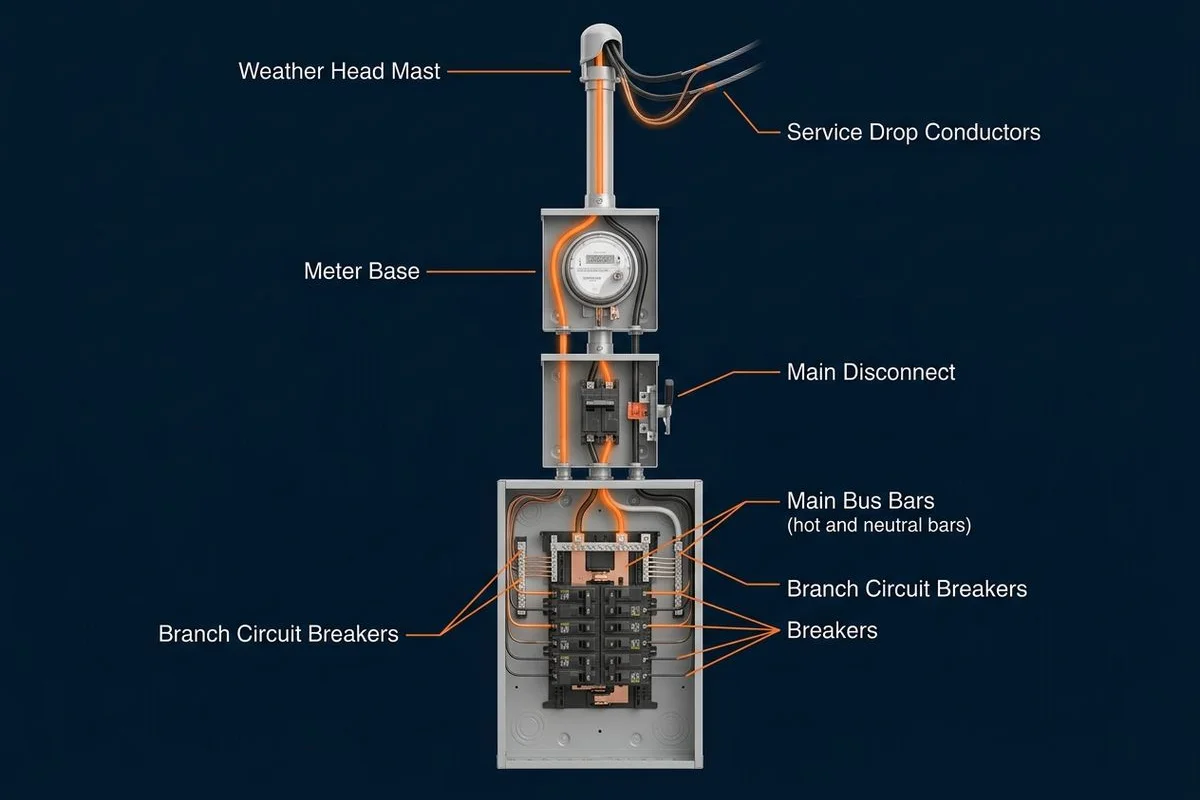
A typical service enhancement replaces several key pieces of infrastructure:
- Main breaker panel: The central hub where power enters and distributes to individual circuits.
- Service mast and weatherhead: The exterior metal pipe that brings utility power lines down to your meter.
- Meter base: The outdoor housing that holds the utility company’s usage monitor.
- Grounding system: Copper rods and bonding wires that direct stray voltage safely into the earth.
We recommend budgeting for potential utility fees during this process. Toronto Hydro sometimes charges up to $678 for a full-service disconnect and upgrade coordination. Knowing these figures upfront helps you compare contractor quotes accurately.
What This Guide Covers
Let’s review the critical points worth knowing before you book any electrical work.
1. Service entrance basics: cable, mast, meter, panel
Toronto homes built before the 1990s typically run on 60A or 100A service. We frequently encounter older housing stock that still relies on undersized exterior cables and deteriorating meter bases.
Replacing just the indoor box does not increase your total power capacity. A true service upgrade involves installing a new, larger mast, heavy-duty utility cable, a modern meter, and the interior panel itself.
Our process starts with submitting the required paperwork to the local utility provider. Toronto Hydro requires a specific timeline for these projects, often taking up to ten business days just to review the initial project details.
Scheduling a temporary power disconnection can take an additional two weeks. Planning ahead prevents major delays during your renovation.
2. Main breaker and bus bar function
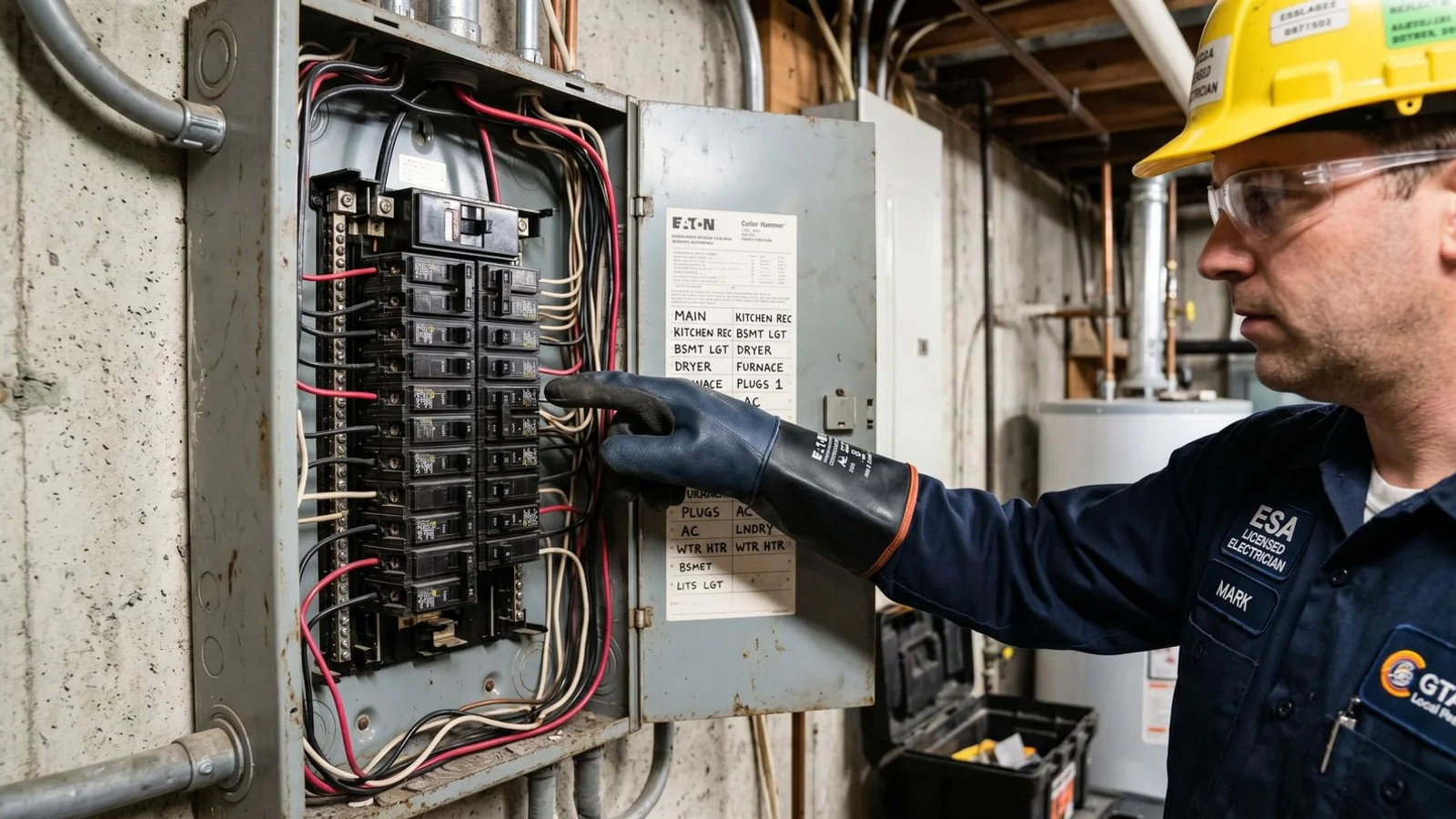
The main breaker panel acts as the master shutoff switch for your entire property. Electricity flows through this switch and travels down the bus bar, which is the solid metal strip supplying power to every individual circuit.
We find that older equipment has dangerous bus bar designs that fail to trip during power surges.
”Federal Pacific Stab-Lok and Zinsco panels are heavily flagged as fire risks by the Electrical Safety Authority and most Canadian insurance companies.”
A new main breaker features a redesigned bus bar that firmly secures modern, highly responsive circuit breakers. Upgrading this core component guarantees that a short circuit in your kitchen will instantly shut off power instead of melting the wires.
3. AFCI and GFCI breakers in current OESC
Current safety regulations place a massive focus on specific breaker types. The 2024 Ontario Electrical Safety Code, which became fully effective in May 2025, mandates strict new protection standards for residential spaces.
We install these required safety devices as a mandatory part of every service enhancement. Older Toronto panels simply pre-date these critical life-saving technologies.
- AFCI (Arc Fault Circuit Interrupter): Required on most 15A and 20A, 125V circuits in living spaces like bedrooms and dining rooms. These prevent fires by detecting sparking from loose wires.
- GFCI (Ground Fault Circuit Interrupter): Mandated for areas prone to moisture, including bathrooms, kitchens, garages, and outdoor receptacles. These shut off power instantly to prevent fatal shocks.
Our installations always include the precise mix of breakers needed to pass the rigorous final inspection. A major renovation automatically triggers the need for these modern retrofits.
4. Common reasons for upgrade (EV, addition, basement suite, insurance)
Most Ontario insurers will not renew a policy on a home with active knob-and-tube, aluminum wiring, or a known hazardous panel. Securing coverage is often the immediate catalyst for booking a replacement.
We also see a massive surge in upgrades driven by electric vehicle purchases. Installing a Level 2 EV charger typically requires a dedicated 40A to 60A circuit, which easily overloads an older 100-amp system.
Other frequent triggers include adding a secondary basement suite, installing a modern heat pump, or building a major home addition.
| Project Type | Typical Power Required | Recommended Minimum Service |
|---|---|---|
| Basic Home (Gas Heat) | 100 Amps | 100 Amps |
| Home with Heat Pump | 125 Amps | 200 Amps |
| EV Charger Addition | 40 - 60 Amps | 200 Amps |
| Legal Basement Suite | 60 - 100 Amps | 200 Amps |
Our certified technicians issue an ESA Certificate of Acceptance after finishing the remediation. This official document is the exact proof your insurance provider needs to close the file and renew your coverage.
5. What gets replaced vs reused in a typical upgrade
In a typical residential project, the workflow is straightforward when handled by an ESA-licensed electrician equipped with the right diagnostic gear. We have managed this exact scope across the entire GTA, including North York, Scarborough, Etobicoke, Mississauga, Vaughan, and Markham.
The steps follow a very consistent and proven pattern.
Many homeowners wonder if any existing components can stay. If your property already has a modern 200-amp exterior meter base and mast, you might only need an indoor service entrance panel swap to gain more breaker slots.
However, if you are increasing your total utility supply, every single component from the street connection to the main breaker must be replaced.
Ready for a Quote?
If you are ready to scope this work, we would be happy to talk. Free estimates are a standard part of our service for residential projects across the GTA.
We provide a flat-rate quote, pull the ESA permits in our own licensed name, and ensure the Certificate of Acceptance is always included.
Visit our electrical panel upgrade page for the full scope of what we do. You can also contact us directly to discuss your specific timelines and power needs.
For more context on related decisions, read our guide on signs Your Toronto Home Needs a Panel Upgrade.
Frequently Asked Questions
What's the difference between 100A and 200A?
+
Twice the available current. Handles modern loads (EV, heat pump, induction range) without tripping or rotating off. For Toronto homes specifically, we handle this through our LEC with the ESA permit included in the flat-rate quote. Free estimates on residential projects.
Does the meter get replaced too?
+
Often yes. Toronto Hydro removes the old meter during disconnect and installs a current-spec one on reconnect. For Toronto homes specifically, we handle this through our LEC with the ESA permit included in the flat-rate quote. Free estimates on residential projects.
What's a bus bar?
+
The metal strip inside the panel that distributes power to each breaker. Corrosion or damage here forces a panel replacement. For Toronto homes specifically, we handle this through our LEC with the ESA permit included in the flat-rate quote. Free estimates on residential projects.