Why Does My Breaker Keep Tripping?
Overload vs short circuit vs ground fault. AFCI nuisance trips, when it's a sign of a bigger problem, and basic safe troubleshooting before calling.
By Michael Chen, Licensed Master Electrician ·
You know how frustrating it is when a single flipped switch plunges half your house into darkness.
Our licensed electricians see this exact scenario every single day in homes and businesses across the GTA.
The breaker trips to cut the power because it detects a potentially dangerous electrical condition. We will break down the specific patterns you need to look for and walk through a safe troubleshooting process.
This guide covers the essential steps you should take before booking a service call.
Why Does My Breaker Keep Tripping?
Your breaker keeps tripping because it is actively protecting your property from an overloaded circuit, a short circuit, or a dangerous ground fault. Our technicians regularly inspect homes where this simple safety mechanism prevented a major electrical fire.
The latest Ontario Electrical Safety Report shows a 10% decrease in electrical distribution fires, largely due to these protective devices working correctly. We want to help you identify the exact cause safely.
There are distinct warning signs that differentiate a minor nuisance from a critical hazard.
What This Guide Covers
Our Toronto Electrical Contractor team handles this scope of work across Toronto, North York, Scarborough, Etobicoke, Mississauga, Vaughan, and Markham. The diagnostic steps follow a consistent pattern depending on your home’s vintage, wall finish, and existing service capacity.
1. Overload vs short circuit vs ground fault (different patterns)
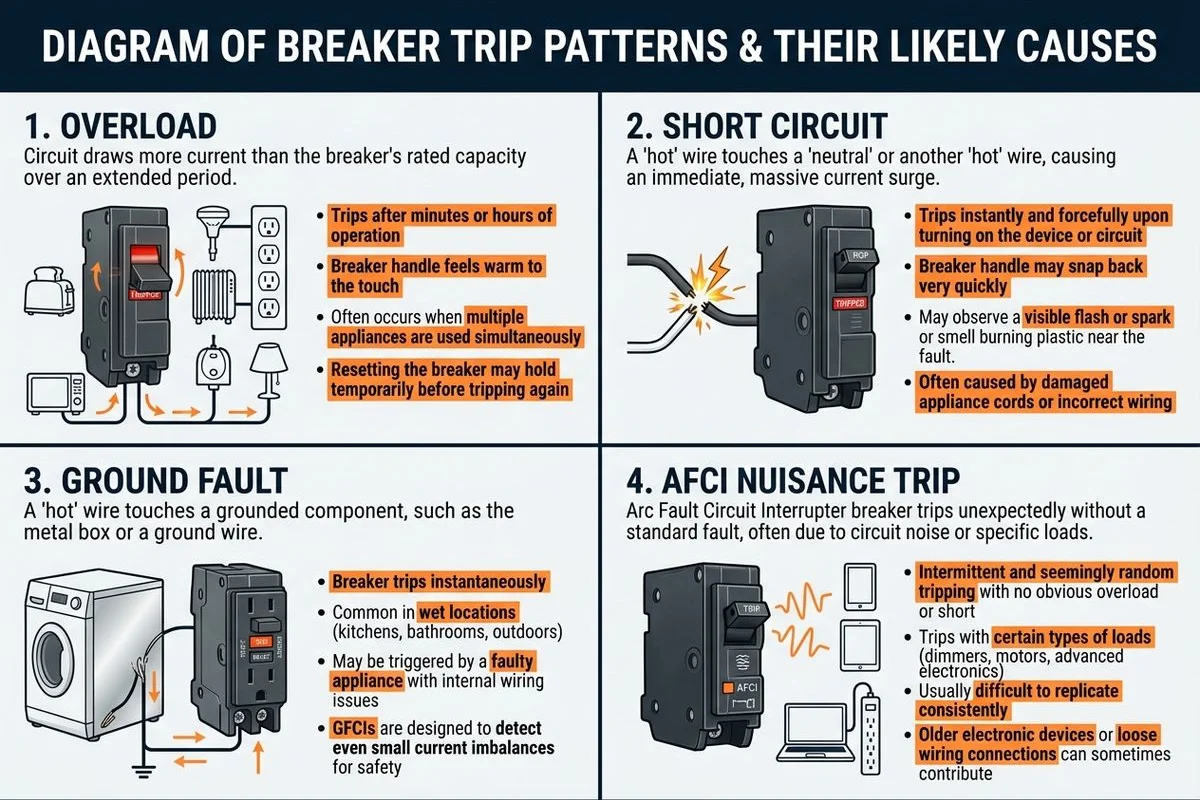
We always start by analyzing the specific way the power cuts out. An overload happens when you draw more power than the circuit can safely carry.
Our team frequently sees 15-amp breakers trip when a 1500-watt space heater and a vacuum run simultaneously on the same 120V line. A standard 15A breaker is designed to handle a continuous load of only 1440 watts safely.
We recommend mapping your panel to understand which outlets share the same circuit. This quick reference table helps narrow down the culprit.
| Fault Type | Common Cause | Trip Pattern |
|---|---|---|
| Overload | Too many heavy appliances running at once. | Trips after a few minutes of appliance use. |
| Short Circuit | Hot wire touches a neutral wire. | Trips instantly with a loud pop or spark. |
| Ground Fault | Hot wire touches the ground wire or metal box. | Trips instantly, often in wet areas like kitchens. |
2. AFCI nuisance trips and how to tell
Our crews install Arc Fault Circuit Interrupter (AFCI) breakers in almost all new residential projects to meet the current Ontario Electrical Safety Code. The ESA first required these for bedrooms in 2002, but the rules expanded significantly in 2015 and 2026 to cover nearly all 15A and 20A living-space circuits.
We understand that these highly sensitive breakers can sometimes cause frustrating nuisance trips. They are designed to detect microscopic sparks from damaged cords or loose outlet connections.
Our go-to trick for diagnosing Siemens AFCI breakers is to read the LED blink code. When you flip a tripped Siemens breaker back to the ON position, it displays an LED light pattern for five seconds.
Here is what the lights mean:
- 1 LED: The breaker detected an arc fault.
- 2 LEDs: The breaker detected an arc fault to the ground.
- 0 LEDs: The breaker tripped due to a standard overload or short circuit.
3. When it’s a sign of a bigger problem (loose neutral, K&T)
We frequently encounter outdated Knob-and-Tube (K&T) wiring in pre-1950 Toronto neighbourhoods like The Annex, High Park, Cabbagetown, and Riverdale. The original cloth insulation degrades over time, and modern blown-in attic insulation traps the heat that these old wires desperately need to dissipate.
Our full removal and rewiring projects for a typical Toronto home usually run between $8,000 and $15,000.
Most Ontario insurers simply refuse to renew policies on homes with active K&T wiring, making full removal a time-sensitive priority.
We also look out for loose neutral connections at the panel, which cause dangerous voltage fluctuations. If your lights flicker noticeably before the breaker trips, you need immediate professional intervention.
4. Basic safe troubleshooting (unplug everything, reset, add back one at a time)
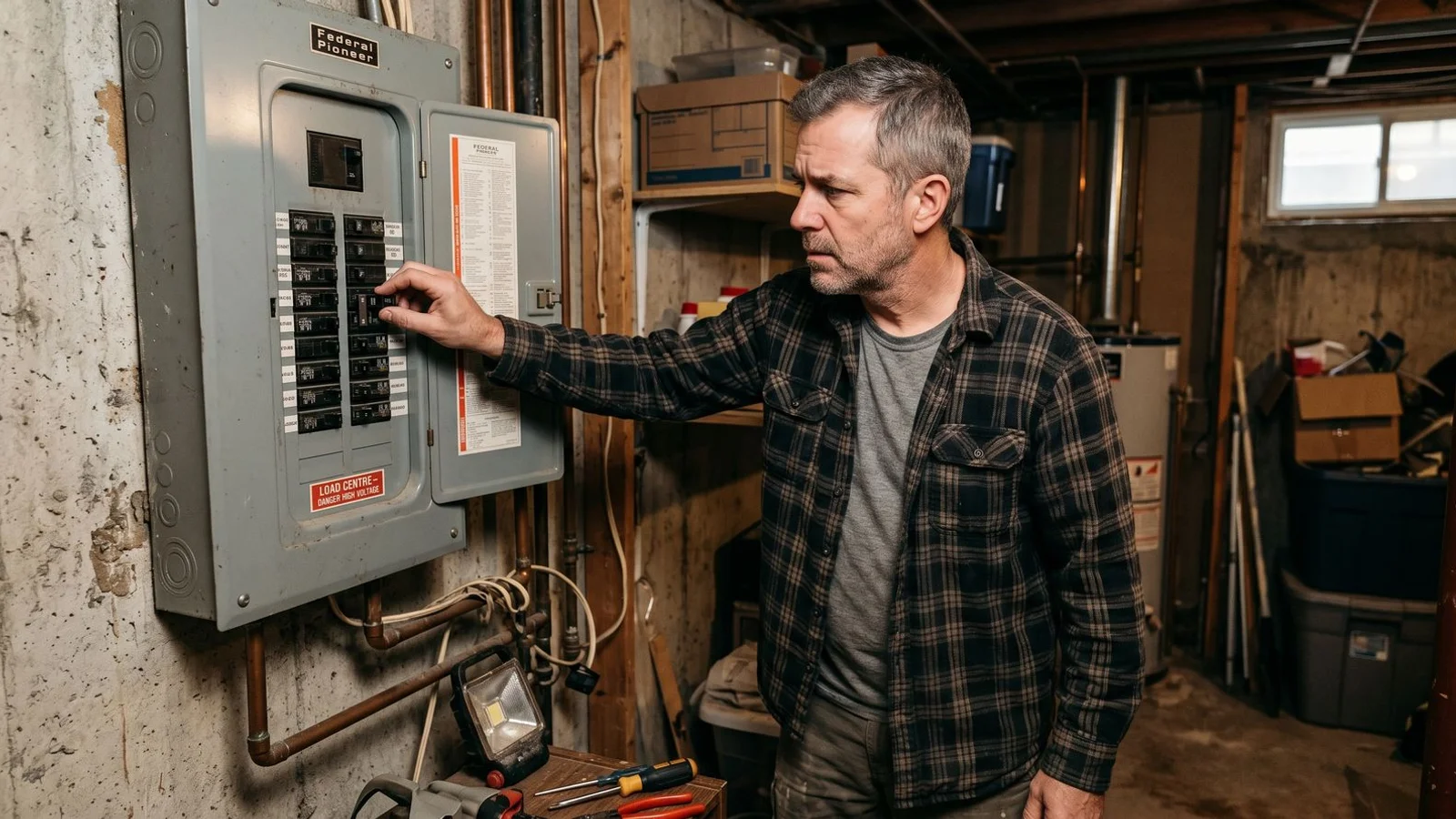
Our safety protocol protects you from unexpected shocks before you ever touch the metal panel. Follow these steps to reset the system safely:
- Unplug every device on the affected circuit to remove the entire electrical load.
- Push the breaker switch firmly to the full OFF position until it clicks.
- Snap the switch back to the ON position.
- Plug items back in one by one to isolate the specific appliance causing the issue.
We frequently see situations where a circuit breaker won’t reset because a heavy appliance is still drawing power. A Level 2 EV charger installation in Toronto runs $800 to $1,500 on average and requires a dedicated heavy-duty circuit to avoid constant tripping.
Our technicians supply and install heavy-duty EV chargers like the Tesla Wall Connector, ChargePoint Home Flex, Wallbox, and Grizzl-E for larger loads. Condo board approval workflows are a mandatory part of that process.
We often install DCC-9 or DCC-11 load management systems for Toronto condo projects to prevent overloading the main building feed.
5. When to stop and call
Our priority is your physical safety when dealing with raw electricity. You must stop and call a professional if the breaker panel feels hot to the touch, emits a buzzing sound, or smells like burning plastic.
We strictly adhere to the Ontario Electrical Safety Code Rule 2-004, which mandates that electrical installation work must be inspected by the Electrical Safety Authority. The 2024 Ontario Electrical Safety Report highlighted a 40% rise in electrical fatalities outside the workplace, with most incidents happening right at home.
Our ESA-licensed electricians carry the right diagnostic gear to test your circuits without putting you at risk. Stop DIY troubleshooting immediately if you notice any of these extreme warning signs:
- Scorched or discolored plastic around the breaker switch.
- A persistent buzzing or humming noise coming from the metal panel box.
- Sparks flying when you attempt to reset the circuit.
- A breaker that instantly trips again the second you reset it.
Ready for a Quote?
Our team provides free estimates on residential electrical projects across the GTA. Every job is flat-rate quoted, and ESA permits are always filed under our Licensed Electrical Contractor name.
We always include your Certificate of Acceptance to guarantee the work is fully code-compliant. Visit our emergency electrician page for the full scope of what our technicians do, or contact us directly to book an appointment.
For more context on related decisions, read our guide on burning Smell From an Outlet: What to Do Right Now.
Frequently Asked Questions
Can I keep resetting the breaker?
+
Once or twice fine; if it trips again immediately, stop and investigate. Repeated resets damage the breaker. For Toronto homes specifically, we handle this through our LEC with the ESA permit included in the flat-rate quote. Free estimates on residential projects.
What's an AFCI nuisance trip?
+
Modern AFCIs sometimes trip on benign loads (vacuums, motors); a competent electrician can confirm vs a real fault. For Toronto homes specifically, we handle this through our LEC with the ESA permit included in the flat-rate quote. Free estimates on residential projects.
Should I just upsize the breaker?
+
No. A breaker matches the wire it protects; oversizing is a fire hazard and code violation. For Toronto homes specifically, we handle this through our LEC with the ESA permit included in the flat-rate quote. Free estimates on residential projects.