DCC-9 / DCC-11 Load Management for Toronto Condo EV Chargers
Right-to-Charge Ontario, DCC-9 vs DCC-11 load-management devices, condo board approvals, and shared-circuit installs for Toronto towers.
By Michael Chen, Licensed Master Electrician ·
Installing a DCC-9 EV charger in your Toronto condo is the best way to put a Level 2 station in your parking spot without requiring a massive building service upgrade.
We hear this exact question every week from local residents. A simple workaround exists using specialized energy management hardware.
DCC-9 / DCC-11 Load Management for Toronto Condo EV Chargers
Our proven approach eliminates the need for expensive electrical panel upgrades in multi-unit buildings. This guide covers the technical specifications and the paperwork required to get your installation approved.
We handle this exact scope of work across the GTA daily.
What This Guide Covers
Quick overview of the points worth knowing before you book any work:
1. Right-to-Charge Ontario context and what it requires from boards
Under the Right to Charge Ontario legislation within the Condominium Act, residents possess clear legal protections when requesting an EV charger installation. We always remind clients that boards cannot simply reject your proposal without a valid, documented reason. A qualified professional must prove the installation violates building codes, compromises structural integrity, or poses a safety risk for a denial to stand.
Our team knows that a formal application triggers a strict 60-day review window for the condo corporation. During this period, the board must review your electrical plans and issue a formal response. We prepare comprehensive packages to ensure this review period goes smoothly.
The financial responsibility for these upgrades generally falls into a few distinct categories.
| Funding Model | Description |
|---|---|
| Owner-Funded | The resident pays for the hardware and individual installation in their deeded spot. |
| Condo-Funded | The corporation covers shared infrastructure like new electrical panels or main conduit lines. |
| Shared Strategy | Multiple owners pool resources to hire one electrician, lowering the per-unit labor costs. |
2. DCC-9 (load shedding) vs DCC-11 (current monitoring), when each is used
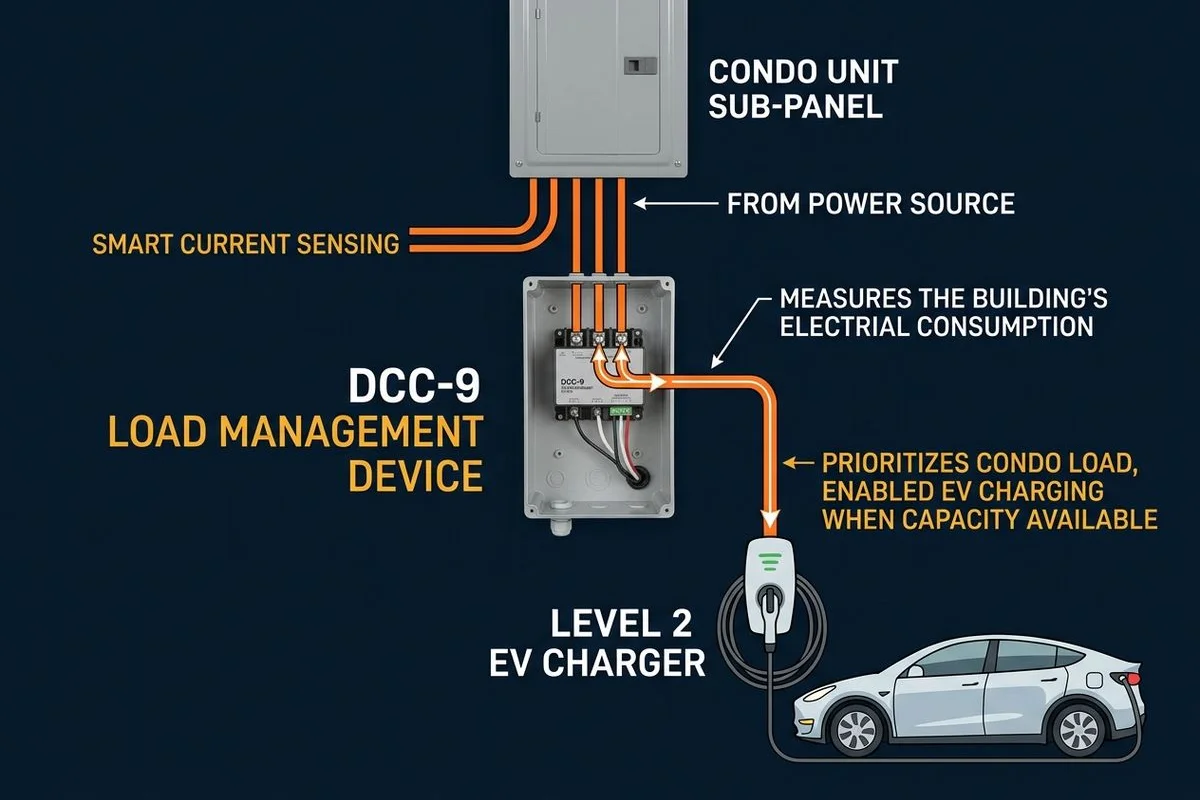
These two Electric Vehicle Energy Management Systems (EVEMS) manufactured by RVE are the industry standard for multi-unit buildings in Canada. We rely on these specific devices to connect your charger directly to your main power supply. The hardware acts as a safeguard by reading the total energy consumption of your panel in real time.
Our preferred method uses a fail-safe current logic that adds zero amps to the building’s official load calculation. Power gets temporarily cut to the charging station if the total load exceeds 80 percent of your main circuit breaker’s capacity.
We select the specific unit based on the size of your existing electrical service.
- DCC-9: Designed specifically for residential electrical panels rated between 60A and 125A.
- DCC-11: Built to handle larger residential services ranging from 150A to 200A, making the DCC-11 Toronto’s top choice for newer high-density developments.
- DCC-BOX strategy: Property managers can install the affordable rough-in box during construction, allowing the resident to purchase the internal electronics later.
3. Condo-board approval workflow we navigate
Submitting a complete technical package is the fastest way to secure board approval. We prepare these detailed proposals to satisfy the strict requirements of Toronto property managers.
Your submission must present a complete picture of the electrical modifications and safety guarantees. Our standard approval package includes a custom electrical single-line diagram showing the exact charger connection.
The hardware specified in the proposal must also bear a recognized CSA safety certification mark. We complete the application by including a formal statement confirming that an ESA-licensed electrician will perform the work.
Pro Tip: Boards are much more likely to approve your request quickly if you explicitly state that the installation will be fully insured under your individual homeowner’s policy.
4. Shared-circuit installs across multiple parking stalls
Coordinating with your neighbors to install multiple charging stations at the same time drastically reduces per-unit costs. We regularly execute shared-circuit strategies in underground parking garages across Toronto.
This approach utilizes networked Level 2 chargers connected to a single electrical panel. Our installations frequently incorporate smart load-sharing software to manage the power distribution automatically.
Platforms from companies like SWTCH or Hypercharge allow residents to pay only for the electricity they personally use. We find that this localized billing completely removes the financial burden from the condo corporation.
- Sub-metering: Installing basic $40 electricity meters allows the condo to bill residents based on manual monthly readings.
- Smart Billing: Networked software automatically tracks individual energy consumption and handles the payment processing.
- Scalability: The shared infrastructure makes it incredibly simple to add more chargers as EV adoption grows in the building.
5. Typical install + paperwork timeline (4-8 weeks)
The legal requirement gives condo boards up to 60 days to process your formal application. We find that the actual physical installation takes only one or two days once the final approval is granted. Getting the mandatory Electrical Safety Authority inspection certificate adds another few days to the total schedule.
Our transparent pricing model ensures you know exactly what to expect before the drilling starts. A typical condo EV charger installation in Toronto for 2026 ranges from $1,500 to $3,500 depending on the complexity of the site.
- Initial Review: Condo boards have up to 60 days to evaluate your submitted engineering drawings.
- Physical Installation: Most single-spot charging setups are completed in one standard business day.
- ESA Inspection: Securing the final provincial safety certificate typically takes an additional two to three days.
We emphasize that long conduit runs across multiple concrete parking levels will naturally push your total cost toward the higher end of that spectrum.
Ready for a Quote?
If you are ready to scope this work, we would be happy to talk. Our technicians provide free, flat-rate estimates on residential projects across the GTA.
The final project always includes full ESA permits in our Licensed Electrical Contractor name, and a Certificate of Acceptance is always provided upon completion.
Visit our ev charger installation page for the full scope of what we do, or contact us directly to get started on your building application.
For more context on related decisions, read our guide on does My Electrical Panel Support an EV Charger?.
Frequently Asked Questions
What's the difference between DCC-9 and DCC-11?
+
DCC-9 sheds the EV charger when the unit's main load is high; DCC-11 monitors current and dynamically modulates. For Toronto homes specifically, we handle this through our LEC with the ESA permit included in the flat-rate quote. Free estimates on residential projects.
Does my condo board have to approve?
+
Yes, but Ontario's Right-to-Charge framework limits the grounds for refusal. Boards can require process compliance, not deny outright. For Toronto homes specifically, we handle this through our LEC with the ESA permit included in the flat-rate quote. Free estimates on residential projects.
How long does the condo install take?
+
Install is usually a single day; paperwork and board approvals stretch the project to 4–8 weeks total. For Toronto homes specifically, we handle this through our LEC with the ESA permit included in the flat-rate quote. Free estimates on residential projects.