Does My Electrical Panel Support an EV Charger?
Load calculation basics, 100A vs 200A capacity for EV, sub-panel options, and signs your Toronto panel is maxed out.
By Michael Chen, Licensed Master Electrician ·
You know the feeling when you finally select the perfect electric vehicle, only to wonder if your home can actually power it.
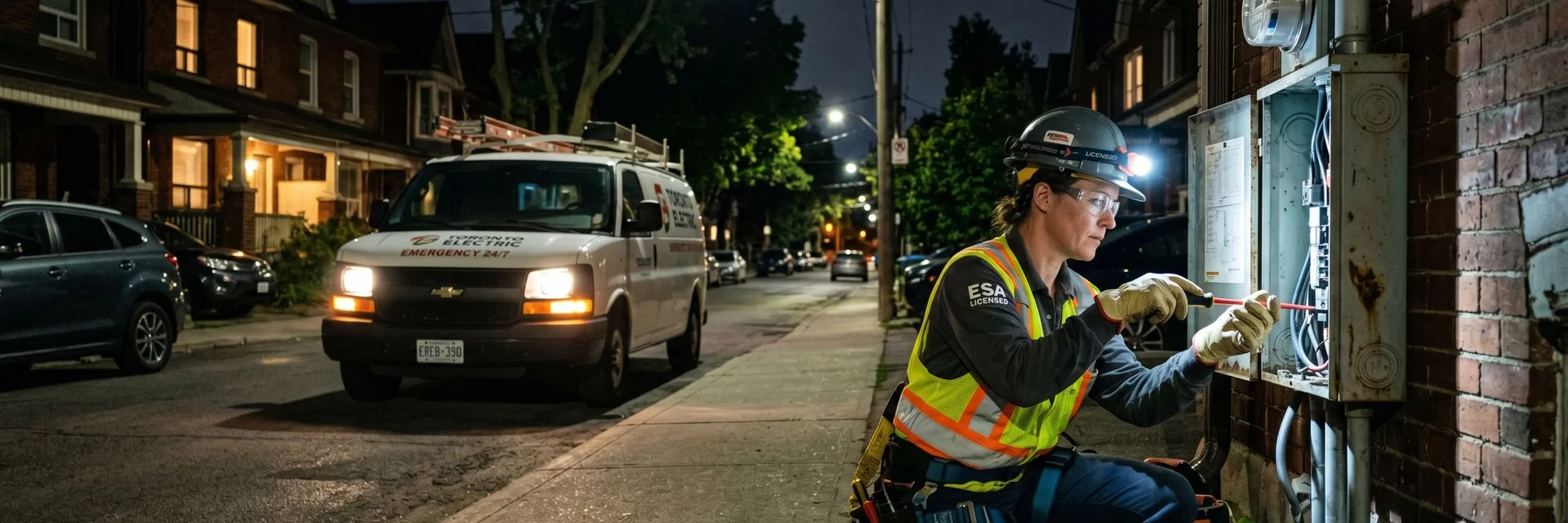
As a dedicated Toronto electrical contractor delivering safe and code-compliant work, we hear the question “does my panel support an ev charger” from local property owners every single day.
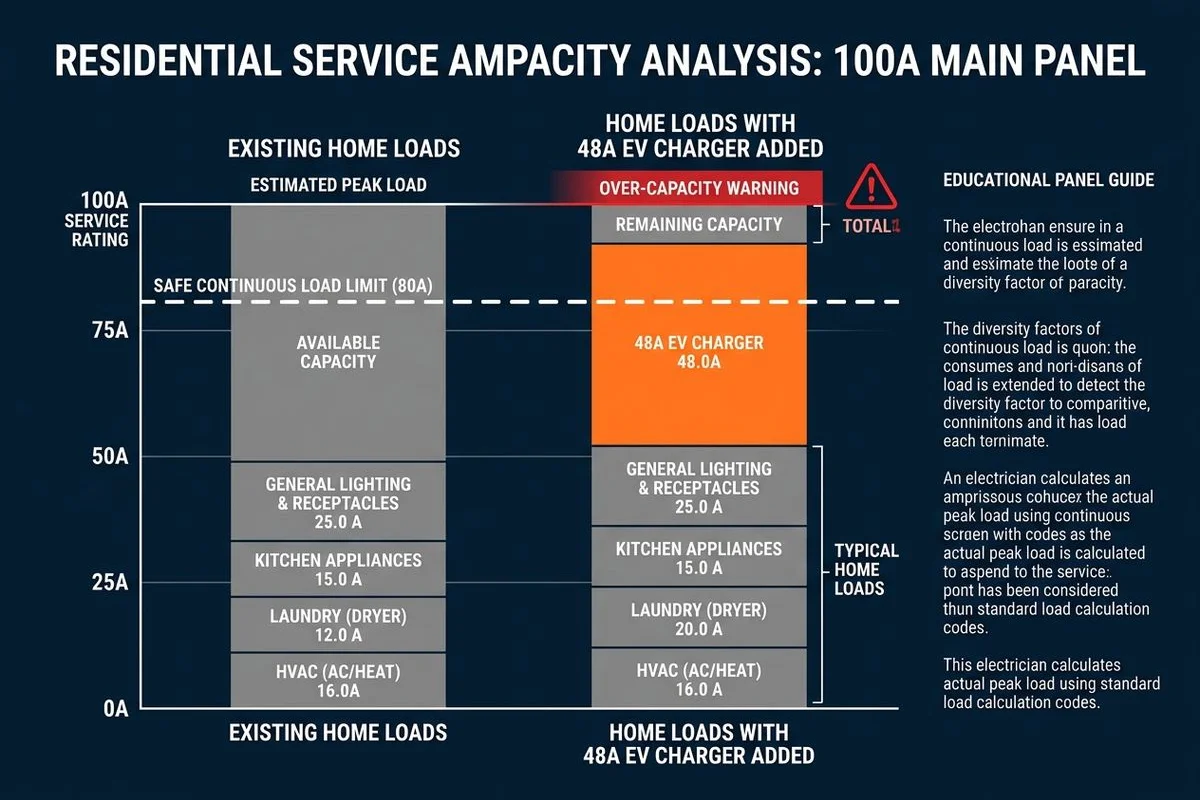
The truth is that a standard 100-amp electrical service usually lacks the capacity for a new 40-amp continuous load, as modern appliances already push these older systems near their limits. Our team will break down the Ontario load calculation rules and walk through the exact workarounds that save buyers thousands.
What This Guide Covers
Quick overview of the points worth knowing before you book any work:
1. Load Calculation Basics (CEC 8-200 Method)
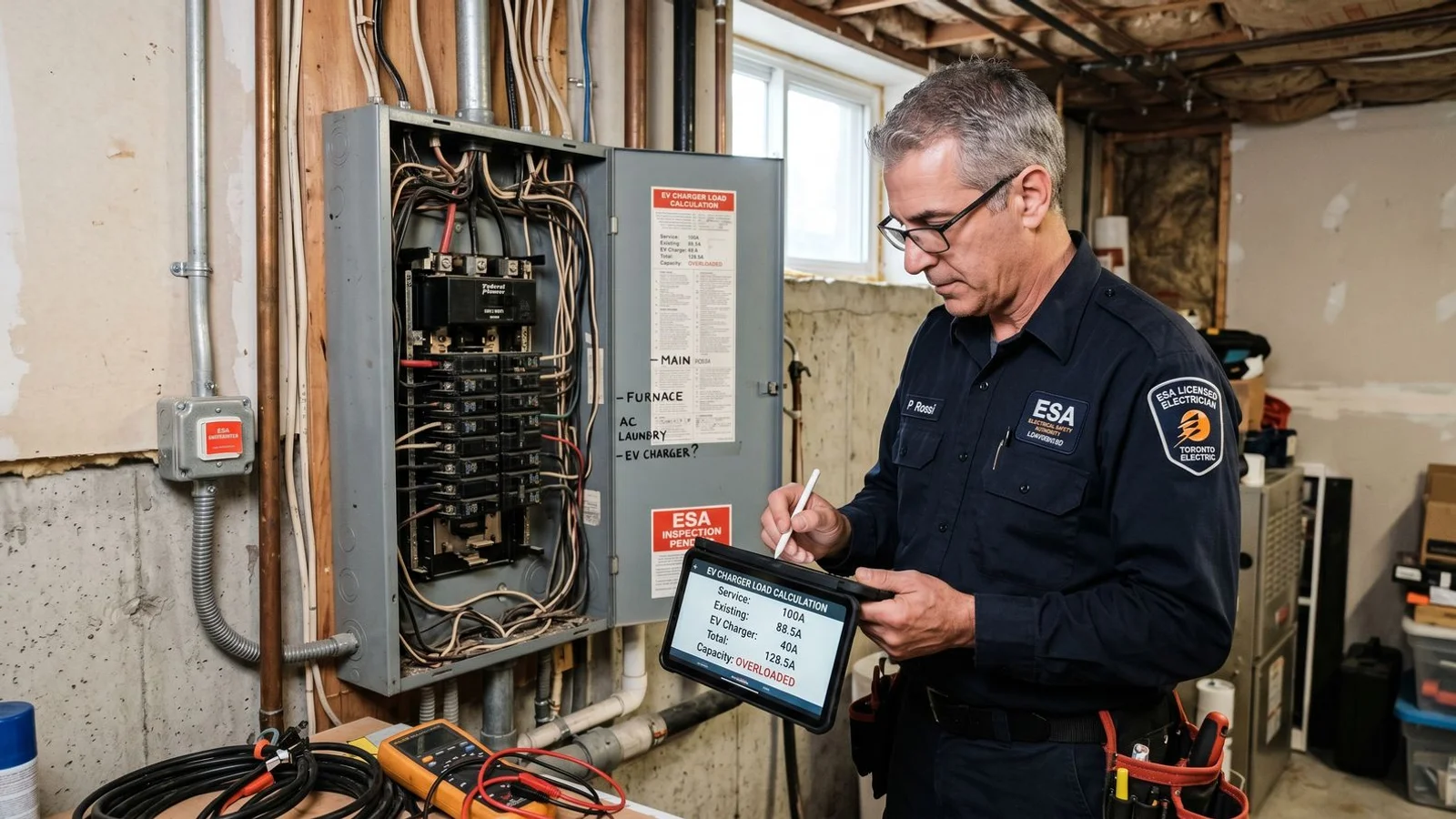
A proper load calculation ev assessment is legally required by the Ontario Electrical Safety Code before installing new charging equipment. This formula, defined under CEC Rule 8-200, is the only authorized way to determine if your home can safely handle the extra draw.
We start by establishing your property’s baseline energy footprint using a strict formula. The size of your home and the type of major appliances you run dictate exactly how much power remains available.
Here is how the standard residential calculation breaks down:
- Base Living Area: The first 90 square metres demands a mandatory 5,000-watt allocation.
- Additional Space: Every subsequent 90 square metres adds another 1,000 watts to your total.
- Electric Ranges: A standard 12,000-watt stove only counts as 6,000 watts for the calculation.
- EV Chargers: These are classified as continuous loads, meaning a 40-amp charger requires a dedicated 50-amp breaker.
Our certified electricians use this exact metric to guarantee your setup passes the final Electrical Safety Authority inspection. This rigorous mathematical check is what prevents overloaded circuits and potential fire hazards in older Toronto properties.
2. 100A vs 200A Capacity: What Is Typically Left for an EV Charger
Toronto homes built before the 1990s typically run on 60-amp or 100-amp service. A standard 100-amp panel simply does not provide the bandwidth needed for a high-speed vehicle charging station alongside modern appliances.
We frequently find that a typical household baseline draw sits between 60 and 80 amps during peak evening hours. If your air conditioner, electric dryer, and oven are running simultaneously, there is virtually zero space left for a new vehicle load.
Determining your exact panel capacity ev charger limit is essential, so here is a quick look at how the two service sizes compare:
| Service Size | Average Usable Capacity | Best Suited For |
|---|---|---|
| 100-Amp Panel | 20 to 40 Amps remaining | Basic appliances, gas heating, Level 1 charging. |
| 200-Amp Panel | 100+ Amps remaining | Electric heat pumps, hot tubs, dual Level 2 EV chargers. |
Federal Pacific Stab-Lok and Zinsco panels are highly common in 1960s to 1980s housing across Etobicoke and Scarborough. The Electrical Safety Authority flags both of these outdated brands as known fire risks, meaning most insurers will mandate a full replacement regardless of your charging needs.
A standard residential 100A to 200A upgrade in Toronto currently runs between $2,500 and $4,500 for a 2026 installation. Our standard replacement packages always include Toronto Hydro disconnect coordination and the final ESA Certificate of Acceptance.
3. Sub-Panel Options When a Service Upgrade Isn’t Feasible
A full utility upgrade is not always realistic, especially in older condominiums or townhomes where the main feed is buried in concrete. If you are trying to install a 100 amp panel ev charger setup without changing the main service line, load management technology is the accepted solution. We specialize in installing Electric Vehicle Energy Management Systems, commonly referred to as EVEMS.
These intelligent devices, like the highly popular DCC-9 controller, sit between your main breaker box and the charging station to monitor total power consumption. If your household draw hits 80 percent of its capacity, the controller automatically pauses the power flowing to your car. Once your heavy appliances cycle off, the system resumes charging your vehicle safely.
This smart workaround completely satisfies the stringent requirements of the provincial electrical code without requiring new utility lines. Our clients prefer this route because it offers massive financial savings compared to traditional trenching or main line replacements.
Here are the primary advantages of choosing a smart load manager:
- Cost Savings: Hardware like the DCC-9 or Emporia systems typically run between $1,200 and $1,800 fully installed, saving you roughly $2,000 over a panel replacement.
- Condo Board Approval: This technology prevents strain on shared building transformers, making it much easier to pass strict strata regulations.
- Overnight Efficiency: Your car still reaches a full charge by morning, as large appliances are rarely running at 3:00 AM.
- Code Compliance: It is fully recognized by the Electrical Safety Authority as a valid method for bypassing standard maximum capacity rules.
4. Signs Your Panel Is Maxed Out (No Spare Slots, Hot Bus, Frequent Trips)
Your home provides clear physical warning signs when the electrical demand exceeds the available supply. Ignoring these indicators before plugging in a powerful new vehicle can lead to melted wiring, blown fuses, or severe hardware damage.
We always look for a few distinct red flags during our initial site visits. The most obvious indicator is a severe lack of physical space inside the metal enclosure.
If every single breaker slot is currently occupied, you cannot safely add a dedicated 50-amp dual-pole breaker for your new car.
Watch for these specific warning signs that indicate your system is completely overloaded:
- Double-Tapped Breakers: This is a serious code violation where two separate wires are crammed into a single breaker terminal because the installer ran out of room.
- Frequent Tripping: If running the microwave and the vacuum at the same time causes a localized blackout, your baseline capacity is already struggling.
- Excessive Heat: A breaker box that feels unusually warm to the touch suggests that the internal bus bar is experiencing thermal overload.
- Flickering Lights: Noticeable dimming when the air conditioner kicks on means the system is dropping voltage under a heavy starting load.
If you notice any of these symptoms, do not attempt to bypass the safety mechanisms. Upgrading to a modern 200-amp unit resolves these issues instantly while providing up to 60 new breaker slots for future home improvements.
5. What a Free Assessment Includes
In a typical Toronto residential project, the diagnostic work is straightforward when handled by an ESA-licensed professional. Our technicians have completed this exact scope across Toronto, North York, Scarborough, Etobicoke, Mississauga, Vaughan, and Markham.
The inspection process follows a strict, standardized pattern to ensure total pricing transparency. We examine the specific vintage of your home, the condition of your drywall, and the exact gauge of your main utility wire.
A thorough site visit involves pulling the metal cover off your current setup to inspect the internal components for hidden corrosion or overloaded connections.
During your free consultation, a certified estimator will complete the following checks:
- Service Line Inspection: A visual check of the incoming wire at the outdoor meter base confirms if the utility side supports higher amperage.
- Hardware Matching: We review your specific equipment choice, like a Tesla Wall Connector or a ChargePoint Home Flex, to determine the necessary conduit size.
- Load Calculation: The estimator runs the official CEC 8-200 math to document your property’s precise baseline power consumption.
- Clear Quoting: We provide a flat-rate proposal that breaks down the hardware, labour, and mandatory permit costs with zero hidden fees.
Every property is unique, but these core steps guarantee your final installation will be safe, compliant, and ready to pass inspection on the first attempt.
Ready for a Quote?
If you are finally ready to stop asking “does my panel support an ev charger” and get some concrete answers, it is time to schedule a professional site visit.
Our team provides completely free estimates on residential power projects across the entire GTA, and every single job is flat-rate quoted with the required ESA permits secured directly under our licensed electrical contractor name.
You will always receive your final Certificate of Acceptance upon completion. Visit our ev charger installation page for a full breakdown of the hardware we support, or contact us directly to book your assessment today.
For more context on related decisions, read our guide on dCC-9 and DCC-11 Load Management for Toronto Condo EV Chargers.
Frequently Asked Questions
Can a 100A service handle a Level 2 EV charger?
+
Sometimes. Depends on existing load (electric heat, AC, range, dryer). A load calculation will confirm. For Toronto homes specifically, we handle this through our LEC with the ESA permit included in the flat-rate quote. Free estimates on residential projects.
What's a sub-panel and when does it help?
+
A secondary panel fed from the main, useful when you want EV-dedicated breakers without a full service upgrade. For Toronto homes specifically, we handle this through our LEC with the ESA permit included in the flat-rate quote. Free estimates on residential projects.
Is the assessment really free?
+
Yes. Included with any EV charger quote, no obligation. For Toronto homes specifically, we handle this through our LEC with the ESA permit included in the flat-rate quote. Free estimates on residential projects.