How Long Does EV Charger Installation Take?
Typical 3–6 hour Level 2 install. Pre-install panel assessment, post-install ESA inspection, and when a panel upgrade extends the timeline.
By Michael Chen, Licensed Master Electrician ·
Homeowner planning around a delivery date for an EV, wants to know how to schedule the install.
How Long Does EV Charger Installation Take?
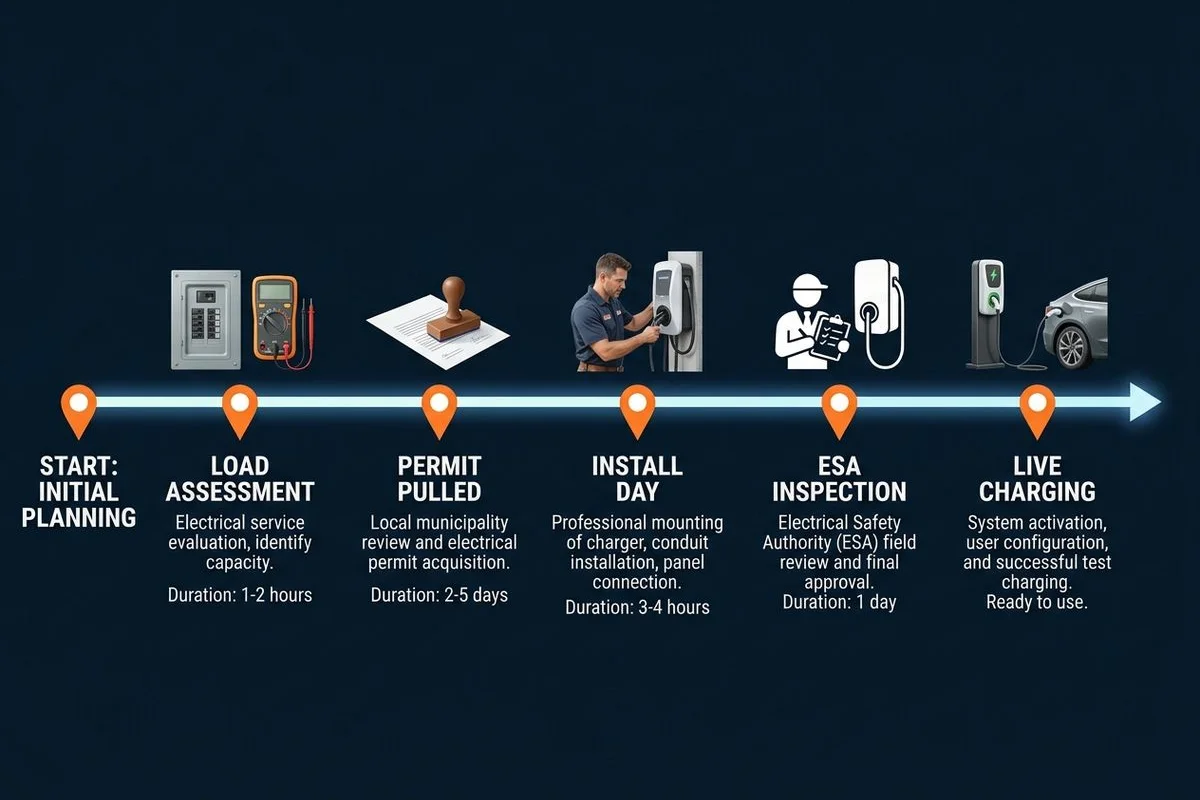
You know how unpredictable construction schedules can feel right now. A typical Level 2 EV charger installation takes between three and six hours of active work on the wall. The entire process from your first quote to final utility approval usually spans two to three weeks.
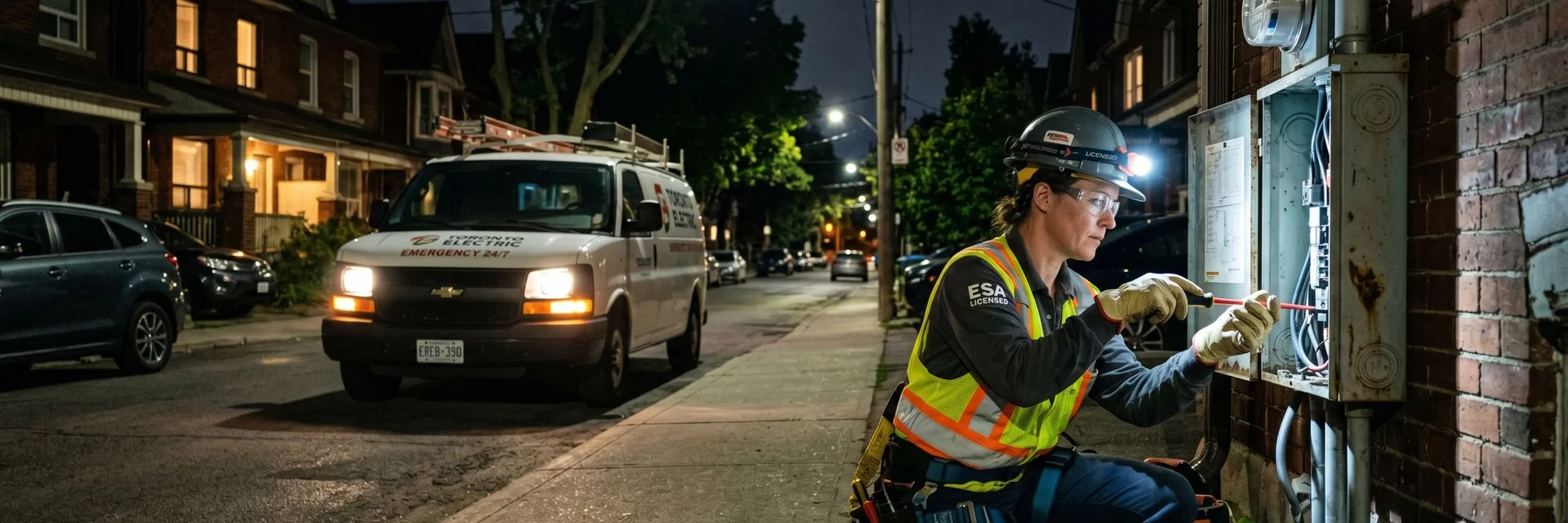
We see a lot of timeline delays happen because homeowners do not factor in the utility coordination phase. Scheduling the assessment, securing utility disconnects, and passing the final Electrical Safety Authority inspection dictates the real timeline. The 2026 wait times for a Toronto Hydro disconnect request currently sit at around two weeks.
Reviewing the data clarifies these scheduling phases and highlights practical ways to speed up your project.
What This Guide Covers
This guide breaks down the five core phases of an EV charger installation, taking you from the initial site assessment to the final ESA permit. Understanding these steps helps you book your contractor at the right time before your vehicle arrives.
1. Typical 3-6 Hour Level 2 Install Window
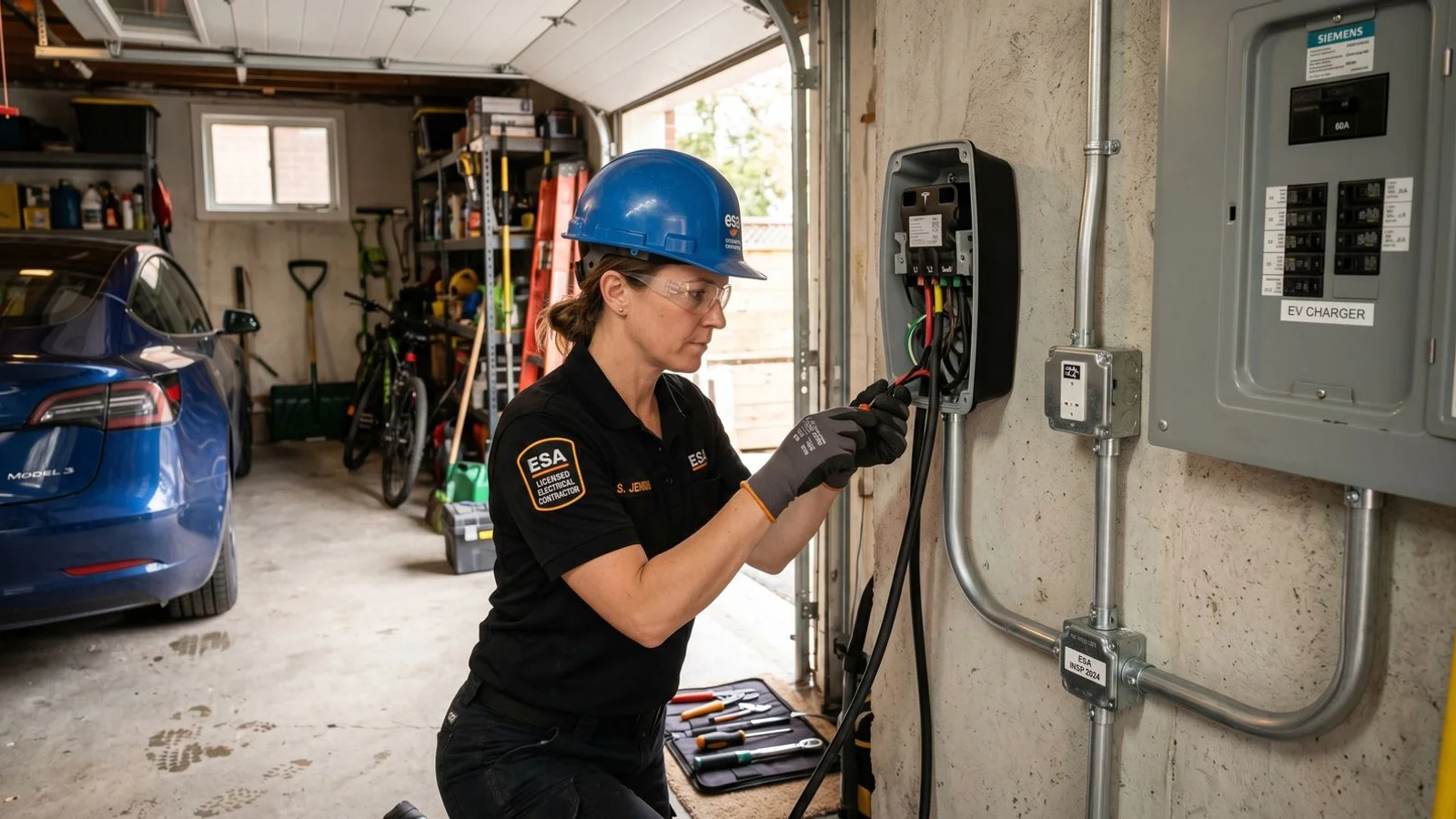
The typical level 2 install duration ranges from three to six hours for a straightforward residential project. This timeline covers running the conduit, mounting the unit, and connecting it to your electrical panel.
We supply standard units like the Tesla Wall Connector, ChargePoint Home Flex, Grizzl-E, and Wallbox. A standard EV charger installation in Toronto runs between $800 and $1,500 CAD on average, including the ESA permit. Hardwired chargers require a dedicated 240-volt circuit, which adds to the material costs if your panel is far from the garage.
Condo installations often face panel capacity limits that can extend the project scope. Our Toronto condo installs frequently require DCC-9 or DCC-11 load management systems manufactured by Thermolec. These energy management devices detect when your condo’s total power consumption exceeds 80 percent and temporarily pause the vehicle charging. This clever workaround avoids a costly panel upgrade and satisfies condo board requirements.
| Install Type | Average Cost (CAD) | Hardware Requirements |
|---|---|---|
| Standard Home | $800 to $1,500 | Dedicated 240V circuit, breaker |
| Condo (Load Managed) | $1,500 to $2,500+ | DCC-9 or DCC-11 system |
2. Pre-Install Panel Assessment (1 Hour)
A pre-install panel assessment takes about one hour and establishes the exact scope of your project. This initial site walk allows an electrician to perform a formal load calculation required by the Ontario Electrical Safety Code.
Our team provides a fixed-price quote within 24 hours of completing this assessment. You should always get the quote in writing with a flat-rate number before any work starts. Hourly plus materials quotes tend to drift, and starting-at pricing without context usually escalates quickly.
A genuine Licensed Electrical Contractor scoping a typical residential job in Toronto, North York, or the Greater Toronto Area will guarantee their pricing. Make sure the assessment verifies your panel has physical space for a new two-pole breaker.
3. Post-Install ESA Inspection Scheduling (5-10 Days)
Satisfying the mandatory ESA inspection EV requirement typically adds five to 10 business days to the end of your project. This inspection verifies that the new dedicated circuit meets all safety standards outlined in ESA Bulletin 86-01.
We bake the permit and inspection cost directly into the flat-rate quote. A real Toronto LEC handles this entirely, meaning you never see a separate line item or pay the ESA directly. The contractor must always pull the ESA permits in their own LEC name.
Homeowner-pulled permits transfer the legal liability directly to you. This approach is not insurance-defensible if an electrical fire occurs later. Having the official Certificate of Acceptance protects your property value and your insurance coverage.
Here are the specific documents you need to complete the compliance process:
- A written flat-rate quote: Provided before work begins.
- An ESA Permit Number: Secured by the contractor before installation.
- A Certificate of Acceptance: Issued by the ESA after the final inspection passes.
4. When a Panel Upgrade Extends the Timeline
Upgrading an outdated electrical panel will add an additional half-day of active labor to your EV charger installation. Factoring in the utility coordination, this upgrade can extend your overall project timeline by two to three weeks.
Many older Toronto homes built before the 1990s still run on 60A or 100A electrical service. Federal Pacific Stab-Lok and Zinsco panels are extremely common in housing from the 1960s to 1980s. Both of these legacy brands are flagged as significant fire risks by the ESA and most home insurers.
Our technicians regularly upgrade these outdated systems to modern 200A service. A standard 100A to 200A upgrade in Toronto costs between $1,800 and $3,500 CAD, including the ESA permit.
This process involves several required steps:
- Pulling a separate ESA permit for the panel change.
- Coordinating a temporary utility disconnect with Toronto Hydro.
- Waiting the standard two-week advance notice for the isolation.
5. Outdoor Installs and Weather Considerations
Installing an EV charger outdoors can add a few hours to the timeline, especially if trenching is required. The equipment must also be housed in a specialized NEMA 3R weatherproof enclosure to survive Canadian winters.
Work remains straightforward when handled by an ESA-licensed electrician equipped with the right diagnostic gear. The exact specifics of the installation depend heavily on your home’s vintage, the exterior wall finish, and the distance to the driveway. If the project requires digging a trench to a detached garage, Ontario law mandates contacting Ontario One Call for a utility locate.
We have managed this specific outdoor scope across the entire GTA, including Toronto, Scarborough, Etobicoke, Mississauga, Vaughan, and Markham. Obtaining a free utility locate takes a minimum of five business days, which must be factored into your schedule.
Ready for a Quote?
Getting a reliable estimate is the best way to finalize your ev charger install timeline. We offer free estimates on residential projects across the GTA to help you plan your EV delivery date.
This consultation process completely removes the guesswork from your budgeting. Every project receives a flat-rate quote, and the team secures all ESA permits under a valid LEC license number.
Your final Certificate of Acceptance is always included with the service. Visit ev charger installation for the full scope of available options, or contact us directly to discuss your specific electrical panel.
For more context on related decisions, read our guide on can I Install an EV Charger Outdoors Through Toronto Winters?.
Frequently Asked Questions
Can I charge my EV the same day as install?
+
Yes, immediately after the work passes our internal QA. Formal ESA inspection follows but doesn't block use. For Toronto homes specifically, we handle this through our LEC with the ESA permit included in the flat-rate quote. Free estimates on residential projects.
How soon can ESA inspect?
+
Typically 5–10 business days after we file the permit notice. For Toronto homes specifically, we handle this through our LEC with the ESA permit included in the flat-rate quote. Free estimates on residential projects.
What if I need a panel upgrade too?
+
Add a half-day for the panel; we coordinate Toronto Hydro disconnect/reconnect in advance to avoid delays. For Toronto homes specifically, we handle this through our LEC with the ESA permit included in the flat-rate quote. Free estimates on residential projects.