What Is a Level 2 EV Charger?
Level 1 vs Level 2 vs DC Fast charging. kW output, miles-per-hour, J1772 standard, and why most Toronto homeowners need Level 2.
By Michael Chen, Licensed Master Electrician ·
You probably know that buying the electric car feels like the easy part, but figuring out how to keep it fueled at home is a whole different project. For a new EV owner trying to understand the basic charging tiers before buying a home charger, the options can feel overwhelming.
Our team sees this confusion daily across Toronto. From what we have noticed, getting the right home setup is the real dividing line between a stressful morning and a smooth commute.
Let’s look at the data to define exactly what is a level 2 ev charger, see what the numbers actually tell us, and walk through the exact steps to take before you book an installation.
What Is a Level 2 EV Charger?
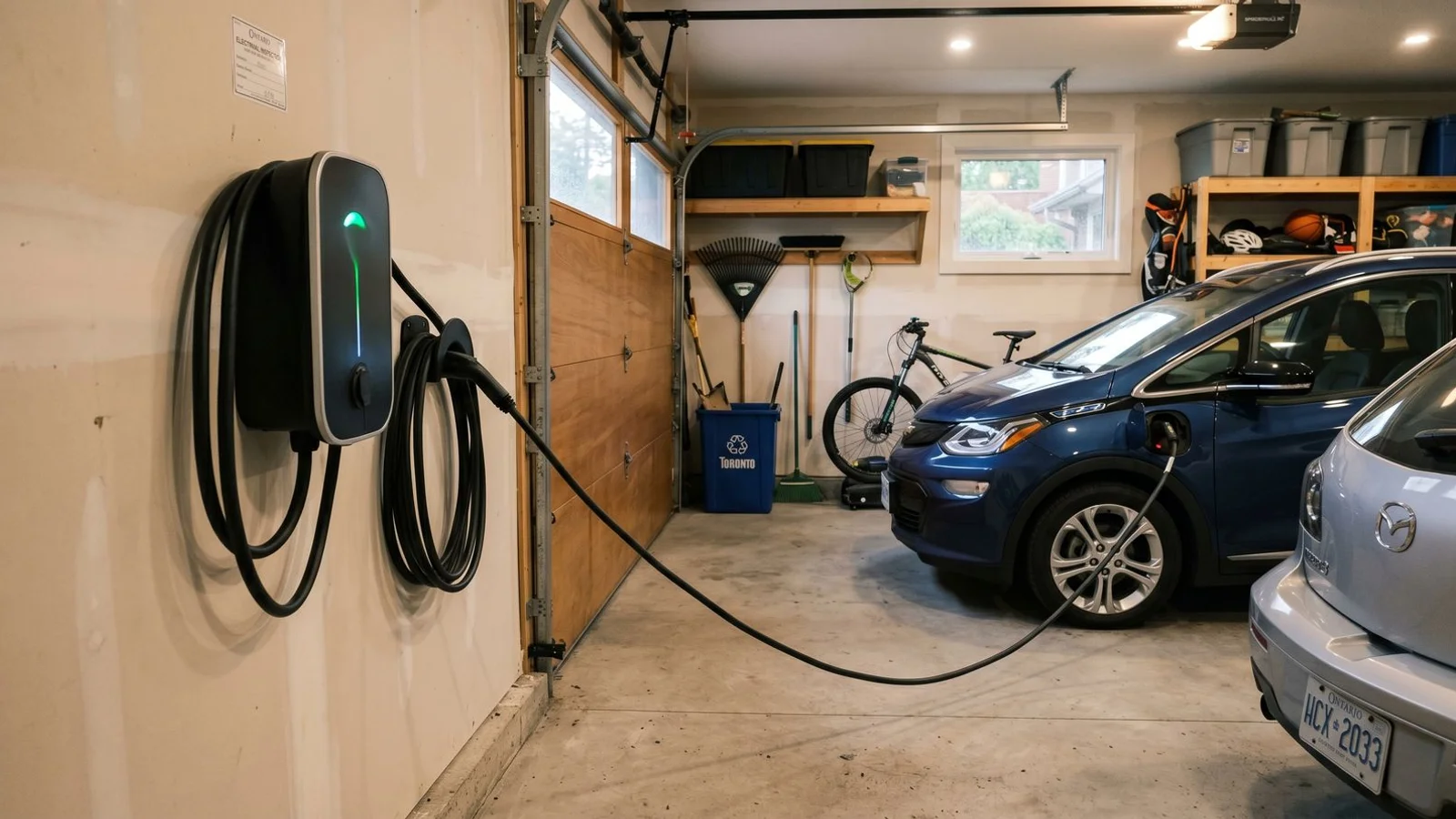
A Level 2 EV charger is a 240-volt charging station that adds about 30 to 50 kilometers of range per hour to your battery. This high-capacity equipment makes it the standard choice for home overnight charging, replacing the slow trickle of a standard wall socket.
Our electricians install these units using a dedicated 240V circuit, similar to what powers an electric stove or heavy-duty dryer. The Electrical Safety Authority (ESA) requires a Notification of Work permit for every single Level 2 installation in Ontario. Skipping this legal step leaves you without a Certificate of Acceptance, which can put your home insurance coverage at risk if an electrical fire occurs.
Here are the main financial advantages of upgrading your home setup:
- Time Savings: Replenish a daily commute in just one hour.
- Rate Arbitrage: Take advantage of off-peak electricity pricing.
- Home Value: Buyers increasingly look for EV-ready properties.
Toronto Hydro’s Ultra-Low Overnight rate for 2026 charges just 3.9 cents per kWh from 11 p.m. to 7 a.m. daily. Our clients use this rate to charge their vehicles for a fraction of daytime energy costs. You can easily program your car’s computer to only draw power during these cheap hours.
What This Guide Covers
Quick overview of the points worth knowing before you book any work:
1. Level 1 (120V trickle) vs Level 2 (240V) vs DC Fast (commercial)
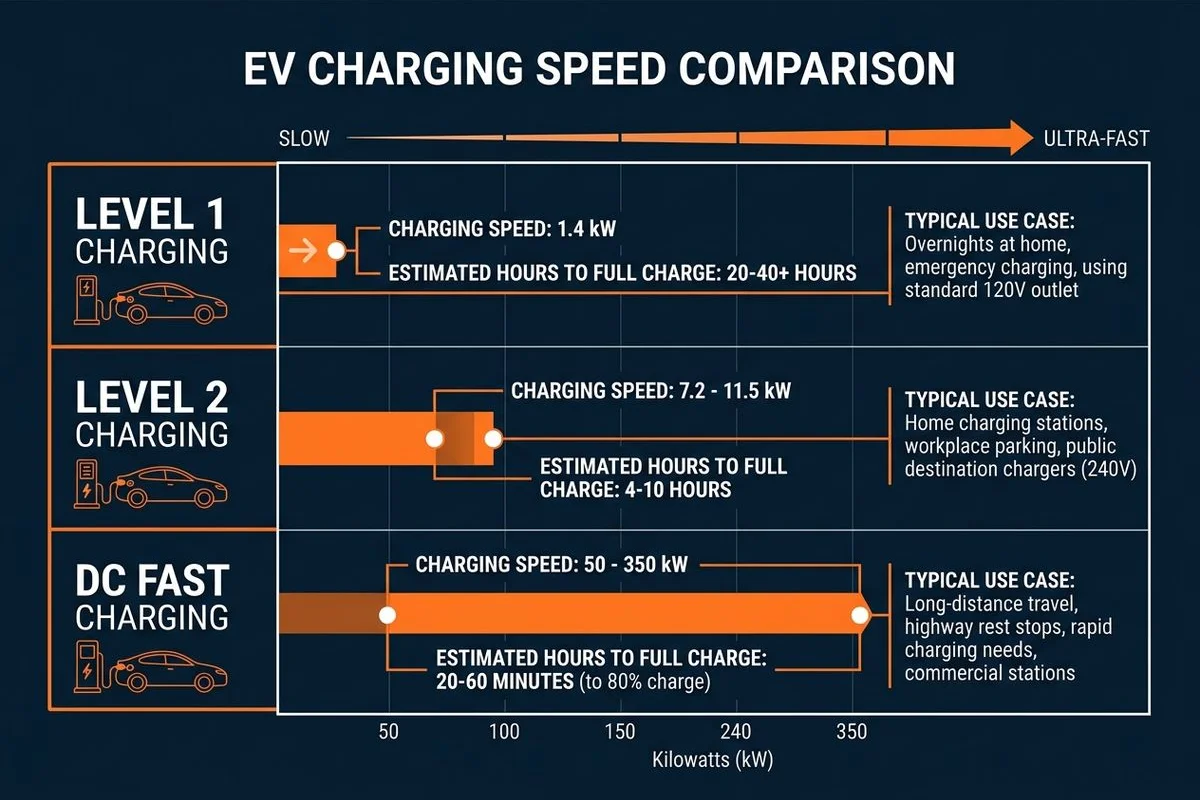
When evaluating a level 1 vs level 2 charger, the difference comes down to voltage and practical charging speed. Level 1 uses a standard household outlet, Level 2 requires a dedicated 240V circuit, and DC Fast is for commercial rapid charging on the highway.
Our customers quickly realize this trickle charge takes over 40 hours to fill a standard 60 kWh battery from empty. Level 2 is the sweet spot for residential use, filling that same battery completely in 6 to 8 hours while you sleep.
Here is a quick breakdown of how the three main tiers compare:
| Charger Tier | Voltage Supply | Time to Full Charge (60 kWh) | Best Practical Use |
|---|---|---|---|
| Level 1 | 120V | 40+ hours | Emergency backup only |
| Level 2 | 240V | 6 to 8 hours | Daily home overnight charging |
| DC Fast | 400V+ | 30 to 45 minutes (to 80%) | Highway road trips |
DC Fast stations, like the Tesla Supercharger network, push high-voltage direct current directly into the battery pack. These commercial stations can degrade battery health if used exclusively, making reliable home equipment your best long-term strategy.
2. kW output ranges, typical Level 2 is 7.2 to 11.5 kW
Most residential Level 2 units output between 7.2 kilowatts and 11.5 kilowatts. Your home’s electrical panel capacity dictates which output you can safely support.
The National Electrical Code (NEC) and the ESA enforce a strict 80 percent continuous load rule for electric vehicle supply equipment. This safety mandate means a 48-amp charger producing 11.5 kW actually requires a dedicated 60-amp circuit breaker to operate safely. Our team regularly performs electrical panel upgrades because an older 100-amp home service simply cannot handle this massive continuous draw.
If you park outside during Canadian winters, we highly recommend heavy-duty units like the Grizzl-E Classic. These locally manufactured chargers feature:
- A fully sealed NEMA 4 cast aluminum enclosure.
- A specialized cold-weather cable that remains flexible down to minus 30 degrees Celsius.
- Simple plug-and-play operation without complicated software requirements.
3. Miles-per-hour-of-charge comparison by tier
A standard Level 1 cable delivers about 3 to 5 miles of range per hour of charging. Upgrading to a Level 2 unit drastically increases this, delivering roughly 20 to 30 miles per hour ev charging capability.
To put this in perspective, research shows an average commuter in Toronto drives about 32 kilometers (20 miles) round trip daily. Our local clients easily replenish this entire daily commute with just a single hour of Level 2 charging. A standard 120V Level 1 plug would need at least five hours just to replace that short trip.
You will notice the biggest difference during the colder months when freezing weather reduces battery efficiency by up to 30 percent. A higher-powered 240V connection ensures your battery is properly preconditioned and fully topped up before you pull out of the driveway.
4. J1772 vs Tesla connector and adapter compatibility
The J1772 standard is the traditional universal plug for non-Tesla electric vehicles in North America. Meanwhile, the North American Charging Standard (NACS) is the proprietary Tesla plug that the entire auto industry is currently adopting.
Major automakers like Ford, GM, and Hyundai are officially switching to the NACS plug for all new vehicles starting in 2025 and 2026. Our installers actively help homeowners future-proof their garages based on this massive industry shift.
“Installing a universal charging station today prevents the need for an expensive hardware swap when you purchase your next electric vehicle.”
If you currently drive an older vehicle with a J1772 port, you can still confidently install a Tesla Universal Wall Connector today. This specific piece of hardware includes an integrated J1772 adapter locked into the dock, allowing you to charge your current vehicle now and easily transition to NACS later.
5. NEMA 14-50 receptacle vs hardwired Level 2 install
A NEMA 14-50 is a heavy-duty 240V plug-in receptacle, identical to an electric range outlet. A hardwired installation, on the other hand, permanently splices the charging unit directly into your electrical panel wiring.
Ontario electrical code now requires a Ground Fault Circuit Interrupter (GFCI) breaker for any new 240V receptacle located in a garage. Most high-quality Level 2 units, like the ChargePoint Home Flex, already feature their own internal ground fault protection. Our crews see constant nuisance tripping when these two identical safety systems monitor the exact same circuit.
Hardwiring the unit solves this problem completely by bypassing the need for an expensive external GFCI breaker. The benefits of choosing a hardwired connection include:
- Lower Material Costs: You save roughly 150 dollars by skipping the GFCI breaker.
- Higher Speeds: Hardwiring safely provides the maximum 48-amp output limit.
- Reliability: You eliminate the risk of nuisance trips leaving you with a dead battery.
Ready for a Quote?
If you are ready to scope this work, we would be happy to talk. Our team provides free estimates on residential projects across the Greater Toronto Area. Every job is flat-rate quoted, with ESA permits filed under our Licensed Electrical Contractor name, and your Certificate of Acceptance is always included.
Visit ev charger installation for the full scope of what we do, or contact us directly.
For more context on related decisions, read our guide on tesla Wall Connector vs ChargePoint vs Grizzl-E (2026).
Frequently Asked Questions
How much faster is Level 2 than Level 1?
+
Roughly 5–8x faster. Level 2 adds 25–40 km of range per hour vs Level 1's 5–8 km. For Toronto homes specifically, we handle this through our LEC with the ESA permit included in the flat-rate quote. Free estimates on residential projects.
Do I need a special outlet for Level 2?
+
Yes. Either a hardwired connection or a 240V NEMA 14-50 receptacle on a dedicated circuit. For Toronto homes specifically, we handle this through our LEC with the ESA permit included in the flat-rate quote. Free estimates on residential projects.
Can a Tesla use a J1772 charger?
+
Yes with the adapter Tesla supplies; conversely most non-Teslas need a J1772 charger natively. For Toronto homes specifically, we handle this through our LEC with the ESA permit included in the flat-rate quote. Free estimates on residential projects.