Active vs Abandoned Knob and Tube
Active circuits vs disconnected K&T, insurer acceptance of partial remediation, ESA inspection report wording, and a clear decision tree.
By Michael Chen, Licensed Master Electrician ·
Homeowner with mixed K&T situation, wondering if partial work satisfies insurer.
Active vs Abandoned Knob and Tube
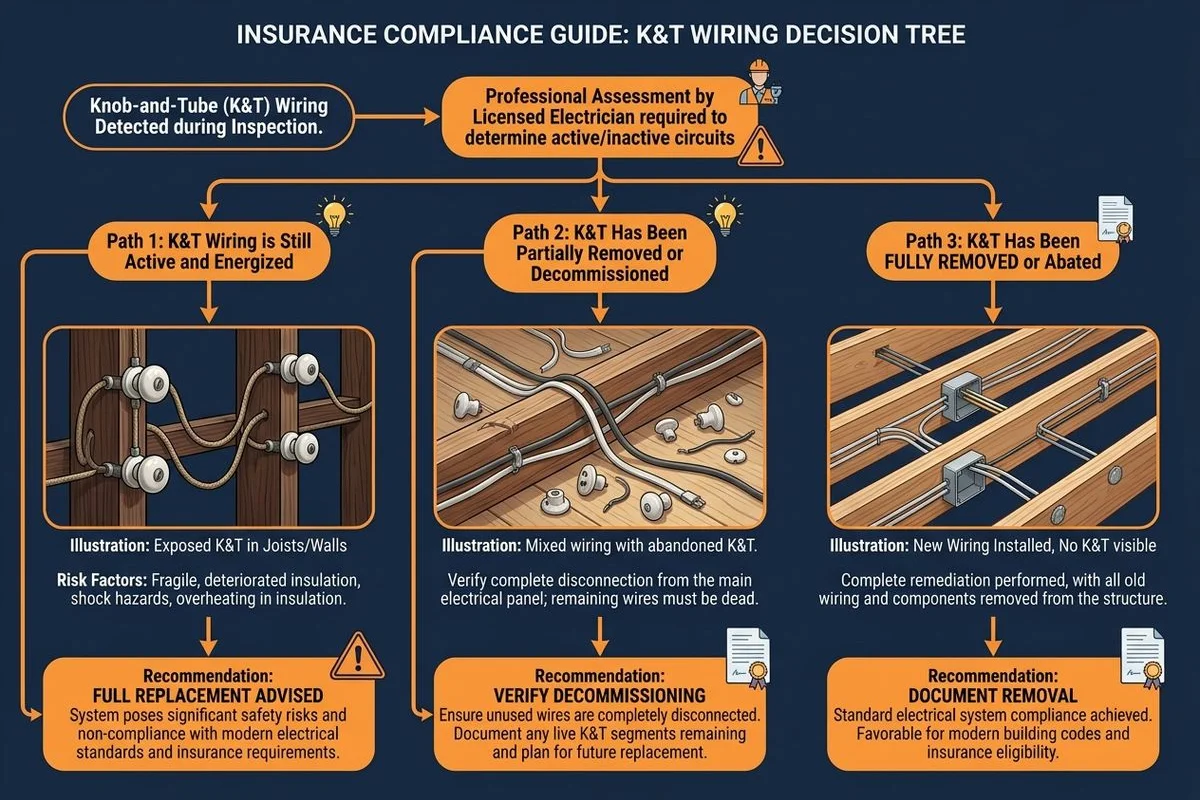
When discussing active vs abandoned knob and tube wiring, the live electrical current is the primary concern, whereas abandoned wiring is safely disconnected and left hidden inside your walls. This distinction is the exact line between passing an insurance inspection and facing a canceled policy.
We regularly help homeowners decide whether a targeted, partial update will satisfy underwriters or if a complete overhaul is necessary. Many property buyers assume every single inch of old wire must be ripped out.
The truth is that careful disconnection often solves the problem without destroying your plaster.
What This Guide Covers
We designed this resource to give you a clear overview of the facts before you book an electrician. Let’s look at the data, what it actually tells us, and then explore a few practical ways to respond.
Knowing your options prevents you from overpaying for unnecessary demolition.
1. Active circuits vs disconnected (abandoned) K&T
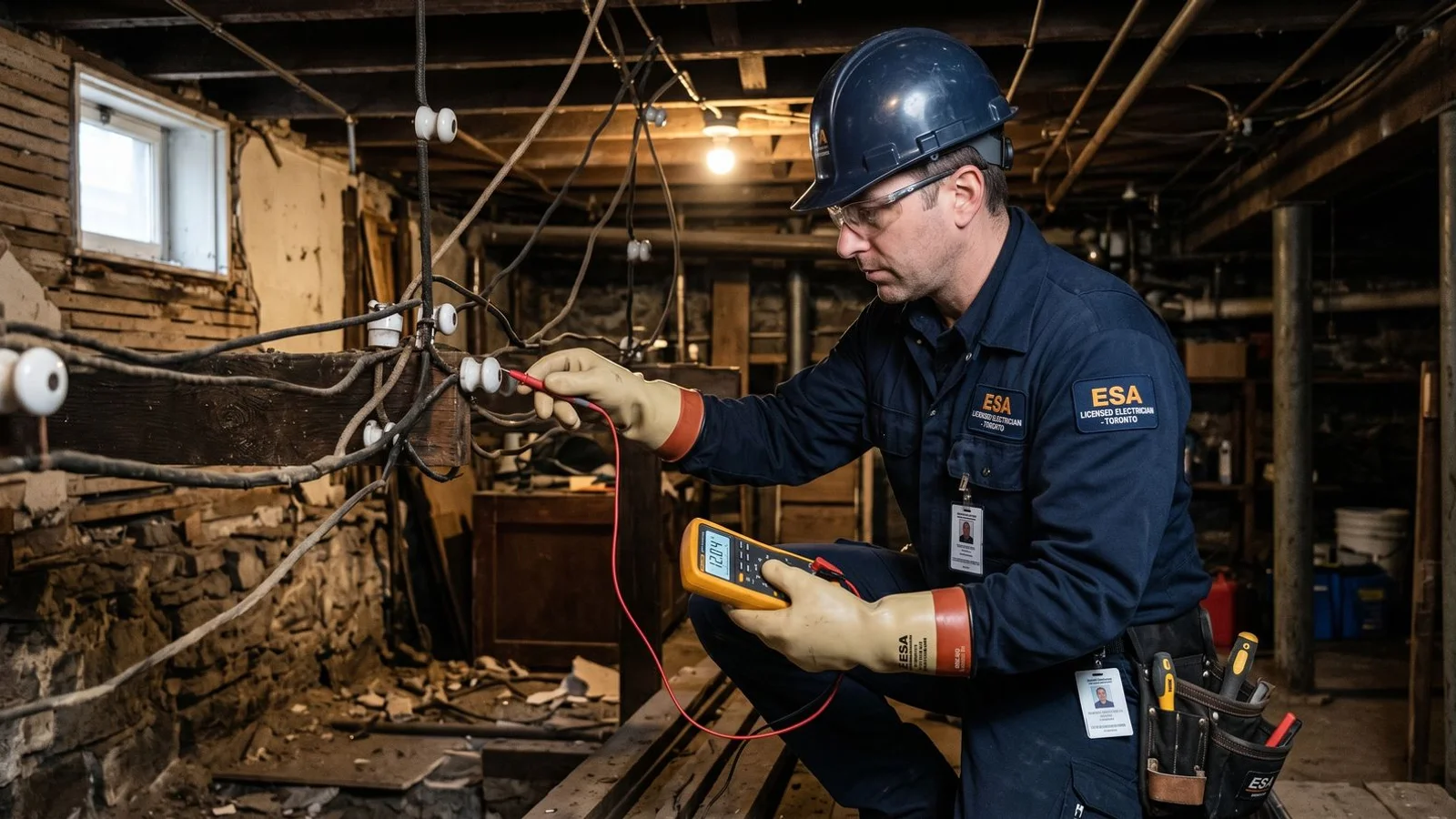
Active circuits mean the k&t still energized with 120 volts of electricity, but disconnected wiring is just dead material left behind to save you money on wall repairs. Our team sees this confusion daily when evaluating pre-1950 Toronto homes in neighbourhoods like The Annex, High Park, Cabbagetown, and Riverdale.
The original cloth insulation degrades over time, and modern attic insulation traps the heat that the original design needed to dissipate. We know that most Ontario insurers refuse to renew coverage on active systems.
A full removal in a typical Toronto home runs between $10,000 and $25,000 as of 2026.
Pro Tip: Abandoning wires instead of ripping them out saves you thousands in drywall patching, provided the connection to the main panel is entirely severed.
2. Insurer acceptance of partial remediation (rare but possible)
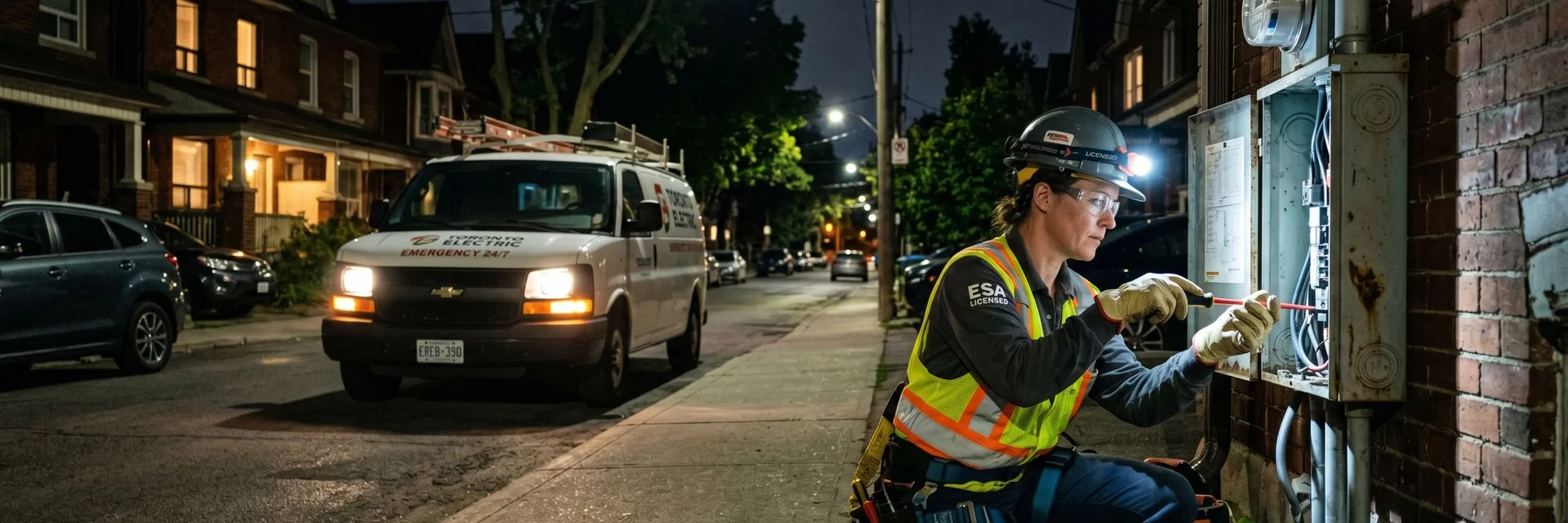
Securing abandoned k&t insurance coverage requires precision, as most Ontario insurers will reject homes with live old wiring. We have successfully guided clients through this exact process across the GTA, including Toronto, North York, Scarborough, Etobicoke, Mississauga, Vaughan, and Markham.
Certain providers like Square One Insurance or TD Bank sometimes offer a 30 to 60-day grace period to complete the electrical work. In a typical residential project, the work is straightforward when handled by an ESA-licensed electrician with the right diagnostic gear.
Our approach follows a consistent pattern to ensure compliance. Specifics depend on your home’s vintage, wall finish, and existing service capacity.
- Documenting the panel: Proving no old circuits remain active.
- Tracing hidden lines: Locating wires inside finished walls.
- Verifying the ground: Ensuring all remaining outlets have proper grounding.
3. ESA inspection report wording that satisfies insurers
Your ESA Certificate of Acceptance must explicitly state that all remaining old wiring has been de-energized and abandoned. We have learned that vague language will immediately trigger a rejection from the underwriter.
ESA permits should always be pulled by the contractor in the Licensed Electrical Contractor’s name. Homeowner-pulled permits transfer liability to the property owner and are not defensible to an insurance company.
Our quotes always bake the permit and inspection costs into a flat-rate number. You never see a separate line item or pay the ESA directly.
Regulatory Fact: A clean, specific ESA report is the only documentation that proves the remaining material poses zero fire risk to an insurance underwriter.
4. Decision tree: what to disconnect vs replace
You must replace any wiring that powers modern appliances, while you can sometimes disconnect and abandon segments running to hard-to-reach light fixtures. We use a specific assessment method to figure out exactly which paths need an upgrade.
Replacing a line to a heavy-draw kitchen appliance is mandatory. Leaving dead wire inside an untouched plaster ceiling is a smart way to control your budget.
Our electricians rely on specialized diagnostic gear to trace these paths safely. In a typical Toronto residential project, the steps follow a consistent pattern to separate the critical zones from the low-risk areas.
| System Component | Action Required | Reason for Action |
|---|---|---|
| Kitchen Outlets | Full Replacement | High amperage draw from modern appliances. |
| Attic Lighting | Full Replacement | Insulation traps heat around the wires. |
| Plaster Wall Runs | Disconnect & Abandon | Dead wire is safe and saves drywall repair. |
5. Cost comparison: partial vs full
A partial knob and tube replacement usually costs between $3,500 and $9,000, while a full home rewire jumps to $15,000 to $25,000 or more. We strongly advise getting the quote in writing with a flat-rate number before any work starts.
“Hourly plus materials” quotes often drift because electricians in Ontario charge between $75 and $125 per hour. Pricing models that say “starting at” usually escalate quickly without context.
Our team provides a fixed price within 24 hours of a site walk for a typical residential job in Toronto, North York, or the GTA. This transparency protects you from surprise bills.
| Project Scope | Estimated 2026 Cost (CAD) | Typical Timeline |
|---|---|---|
| Partial Remediation | $3,500 to $9,000 | 2 to 4 Days |
| Full Home Rewire | $15,000 to $25,000+ | 1 to 2 Weeks |
Ready for a Quote?
Our team is ready to help you scope this work and determine the best approach for your active vs abandoned knob and tube situation. If you want to discuss your options, scheduling an inspection is the first step.
We do free estimates on residential projects across the GTA, complete with flat-rate quotes and ESA permits in our name. The Certificate of Acceptance is always included to keep your insurer happy.
Visit knob and tube wiring replacement for the full scope of what we do.
You can also contact us directly to book an assessment.
For more context on related decisions, read our guide on heritage Homes, Plaster Walls, and Knob-and-Tube Removal.
Frequently Asked Questions
If K&T is abandoned, do I still need to remove it?
+
Usually no for insurance. Proven disconnection is typically sufficient; physical removal is a clean-up choice. For Toronto homes specifically, we handle this through our LEC with the ESA permit included in the flat-rate quote. Free estimates on residential projects.
Will my insurer accept partial replacement?
+
Rarely. Most insurers require full active-K&T removal. For Toronto homes specifically, we handle this through our LEC with the ESA permit included in the flat-rate quote. Free estimates on residential projects.
How do you prove a circuit is abandoned?
+
Physical disconnection at the source plus ESA documentation; we provide both. For Toronto homes specifically, we handle this through our LEC with the ESA permit included in the flat-rate quote. Free estimates on residential projects.