Knob and Tube Replacement Cost in Ontario
Cost ranges across Ontario, square-footage drivers, plaster vs drywall impact, partial vs full pricing, and financing options.
By Michael Chen, Licensed Master Electrician ·
Knob and Tube Replacement Cost in Ontario
Our Toronto Electrical Contractor team witnesses daily how outdated wiring impacts property sales and safety across the province.
Discovering old ceramic knobs in your basement often triggers an immediate scramble to find accurate pricing. The knob and tube replacement cost ontario property owners face is typically the deciding factor between closing a real estate deal or losing insurance coverage.
We know you need real numbers, not vague estimates. The final price for this project depends heavily on your home’s footprint and wall construction. A standard two-story home in the GTA will run significantly higher than a small single-story bungalow.
Our guide breaks down the exact figures you should expect to pay this year, the reasons why insurance companies mandate these upgrades, and the smartest ways to approach the project. This specific data will help you budget accurately. Preparation makes the entire replacement process much smoother.
What This Guide Covers
Our quick overview below highlights the critical points worth knowing before you book any work. You need a solid understanding of the variables that dictate your final invoice. Here are the specific details that drive pricing and project timelines.
1. Cost ranges across Ontario ($8,000-$20,000+ for full home)
We always recommend getting the quote in writing with a flat-rate number before any work starts. Hourly plus materials quotes often drift out of control, and starting at pricing without context usually escalates quickly. A real Licensed Electrical Contractor scoping a typical residential job in Toronto, North York, or the GTA will give you a fixed price within 24 hours of a site walk.
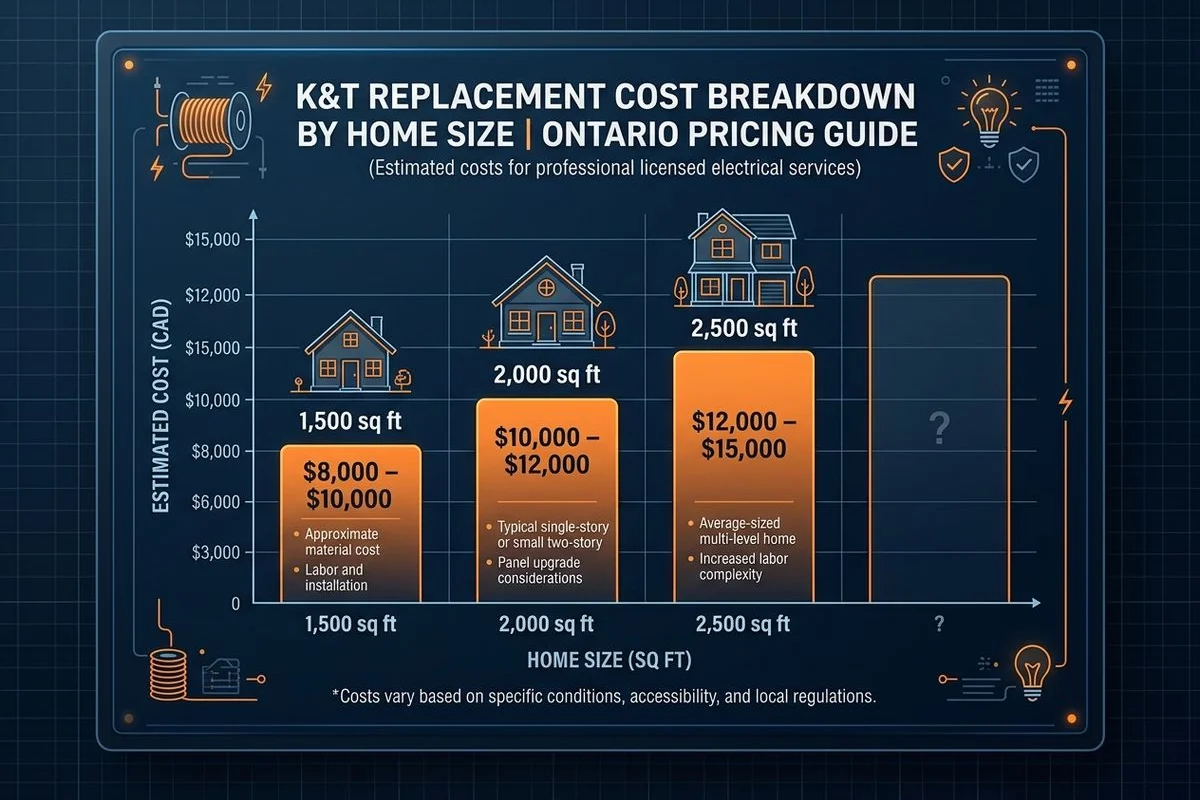
Our team tracks these pricing trends closely across the province. Current 2026 data shows that the whole home rewire cost ontario averages between $10 and $22 per square foot. The final tally depends entirely on your home size and accessibility.
We urge homeowners to account for mandatory Electrical Safety Authority (ESA) permits, which generally run between $100 and $500.
| Home Size | Average Cost Range (CAD) |
|---|---|
| Small Bungalow (800 sq ft) | $8,000 - $16,000 |
| Mid-Size Home (1,500 sq ft) | $15,000 - $30,000 |
| Large Home (2,500+ sq ft) | $20,000 - $50,000+ |
2. Square footage as primary driver
Square footage naturally dictates the length of wire required and the hours needed to run it. In a typical residential project, the work is straightforward when handled by an ESA-licensed electrician equipped with proper diagnostic gear.
We have handled this scope across the GTA, including Toronto, North York, Scarborough, Etobicoke, Mississauga, Vaughan, and Markham, and the steps follow a consistent pattern. The physical distance between your main panel and the furthest bedroom drastically impacts the k&t rewire price. Modern households require significant power, making existing service capacity a major cost factor.
Our electricians see old knob and tube systems fail repeatedly under the demand of contemporary electronics. Consider these standard electrical capacity milestones:
- 60 Amps: The maximum capacity of most original knob and tube systems.
- 100 Amps: The absolute minimum requirement for basic home insurance coverage in Ontario.
- 200 Amps: The recommended standard for modern homes supporting EV chargers, hot tubs, and heavy appliances.
Upgrading an old panel alongside a rewire adds roughly $2,000 to $3,500 to the total budget.
3. Plaster vs drywall impact on labour
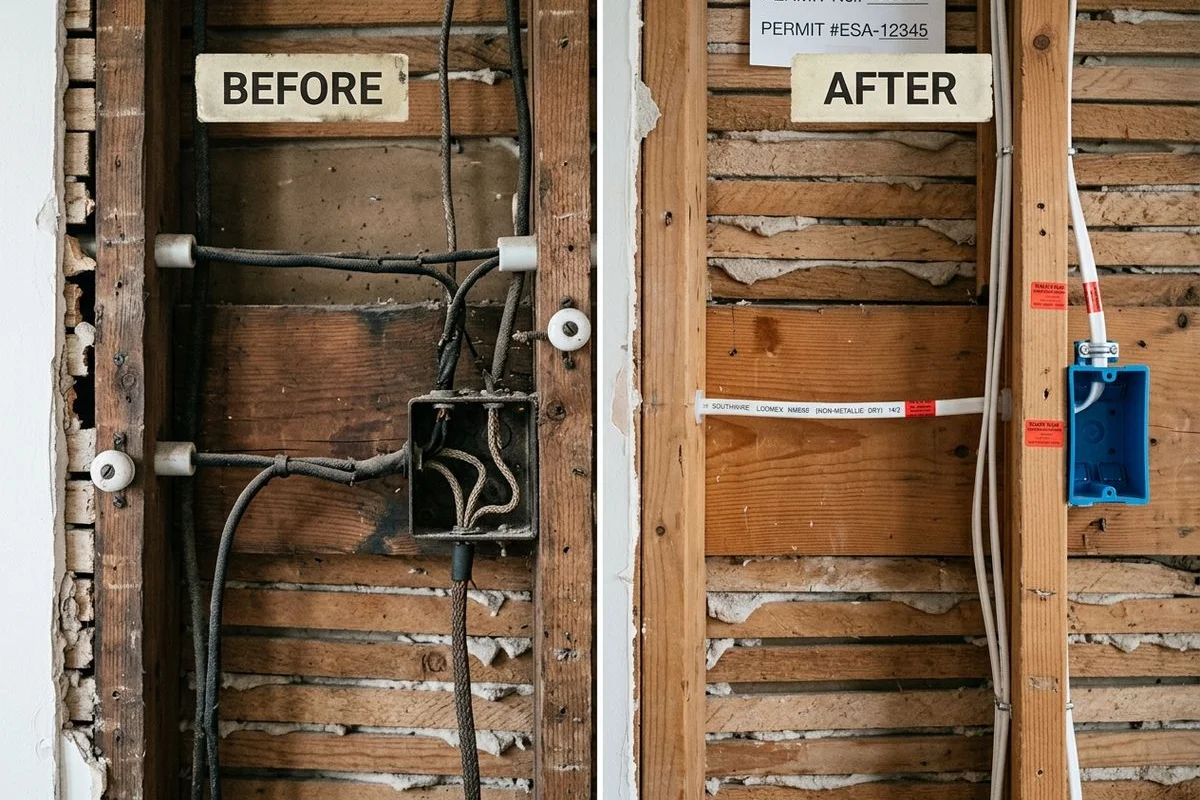
We approach these projects systematically, as the specifics depend heavily on the home’s vintage and wall finish. The material covering your walls significantly influences the final labour bill. Fishing new wiring behind century-old lath and plaster takes far more skill and time than cutting into modern drywall.
Our crews must carefully snake wires through confined spaces to minimize damage to historic interior finishes. An unfinished basement or accessible attic provides clear pathways, which dramatically reduces the time spent opening up walls. Several key variables will increase your patching and painting expenses:
- Extensive presence of historic lath and plaster
- Finished ceilings with no attic access above
- Spray foam insulation blocking wall cavities
- The need for professional drywall patching and painting
We use specialized tools to fish wires with surgical precision, saving you significant repair costs. This careful process minimizes unnecessary disruption throughout your living space. Homeowners appreciate keeping their original architectural details intact.
4. Partial vs full pricing breakdown
We hear many homeowners ask if they can replace only the accessible wiring to save money. The reality is that partial upgrades rarely satisfy strict Ontario Electrical Safety Code (OESC) requirements. Some unlicensed contractors might suggest installing three-prong GFCI outlets on existing two-wire knob and tube circuits as a cheap fix.
We strongly warn against this dangerous shortcut. This tactic will not earn the required ESA Certificate of Acceptance, leaving you with an uninsurable property. Consider these major risks of a partial upgrade:
- Active knob and tube remains ungrounded and unsafe for modern appliances.
- Insurance providers still flag the home as a high fire risk.
- Mixed electrical systems easily violate Ontario Electrical Safety Code rules.
Our full rewire guarantees that your electrical system is completely grounded and capable of handling modern loads safely. Mixing old and new wiring systems without proper isolation is a severe fire hazard. Complete replacement remains the only way to secure the documentation needed for a smooth real estate transaction.
5. Financing and insurance-driven urgency angles
We see most Ontario insurers flatly refuse to renew a policy on a home with active knob-and-tube, aluminum wiring, or a Federal Pacific Stab-Lok panel. Major providers like Intact, Desjardins, and Wawanesa view these outdated systems as an unacceptable fire risk. The ESA Certificate of Acceptance issued after remediation is the vital document that closes the file.
Our clients often scramble to secure this certificate within a tight 30-day window mandated by their new insurance provider. Without it, even properly completed work will not satisfy the insurer because there is no permit-trail proof the upgrade meets current OESC standards. Removing the active knob and tube wiring can actually drop your annual insurance premiums by $300 to $800, providing long-term financial relief.
The ESA Certificate of Acceptance is the only document that proves to insurers and buyers that your electrical system meets current safety standards.
We know that delaying this project often leads to closing delays or outright mortgage refusals. Upgrading your system immediately protects your family from hidden electrical fires. This crucial investment permanently safeguards your property’s long-term resale value.
Ready for a Quote?
Our team is happy to talk if you are ready to scope this work. Securing an accurate knob tube replacement quote is the first step to a safer home. Every job receives a free estimate for residential projects across the GTA.
We pull all necessary ESA permits in our LEC name, and the final Certificate of Acceptance is always included. Understanding your knob and tube replacement cost ontario is easy when you have transparent, upfront pricing. Visit our knob and tube wiring replacement page for the full scope of what we do, or contact us directly to schedule your site walk.
For more context on related decisions, read our guide on knob and Tube vs Aluminum Wiring: Which Is the Bigger Insurance Risk?.
Frequently Asked Questions
What's the typical cost for a 2,000 sq ft Toronto home?
+
Roughly $10,000–$14,000 for a full active-K&T replacement, plaster-walled, with permits. For Toronto homes specifically, we handle this through our LEC with the ESA permit included in the flat-rate quote. Free estimates on residential projects.
Is financing available?
+
Some homeowners use HELOCs or insurer-driven cure financing; we don't offer in-house financing. For Toronto homes specifically, we handle this through our LEC with the ESA permit included in the flat-rate quote. Free estimates on residential projects.
Does the price include the patching?
+
Yes. Patching to paint-ready is in scope; finish painting is homeowner or painter. For Toronto homes specifically, we handle this through our LEC with the ESA permit included in the flat-rate quote. Free estimates on residential projects.