Knob and Tube vs Aluminum Wiring
Side-by-side hazard profile, insurer treatment differences, remediation cost differences, and what to do if a Toronto home has both.
By Michael Chen, Licensed Master Electrician ·
Buyer or owner researching both legacy concerns at once, wants to know which is worse.
Knob and Tube vs Aluminum Wiring
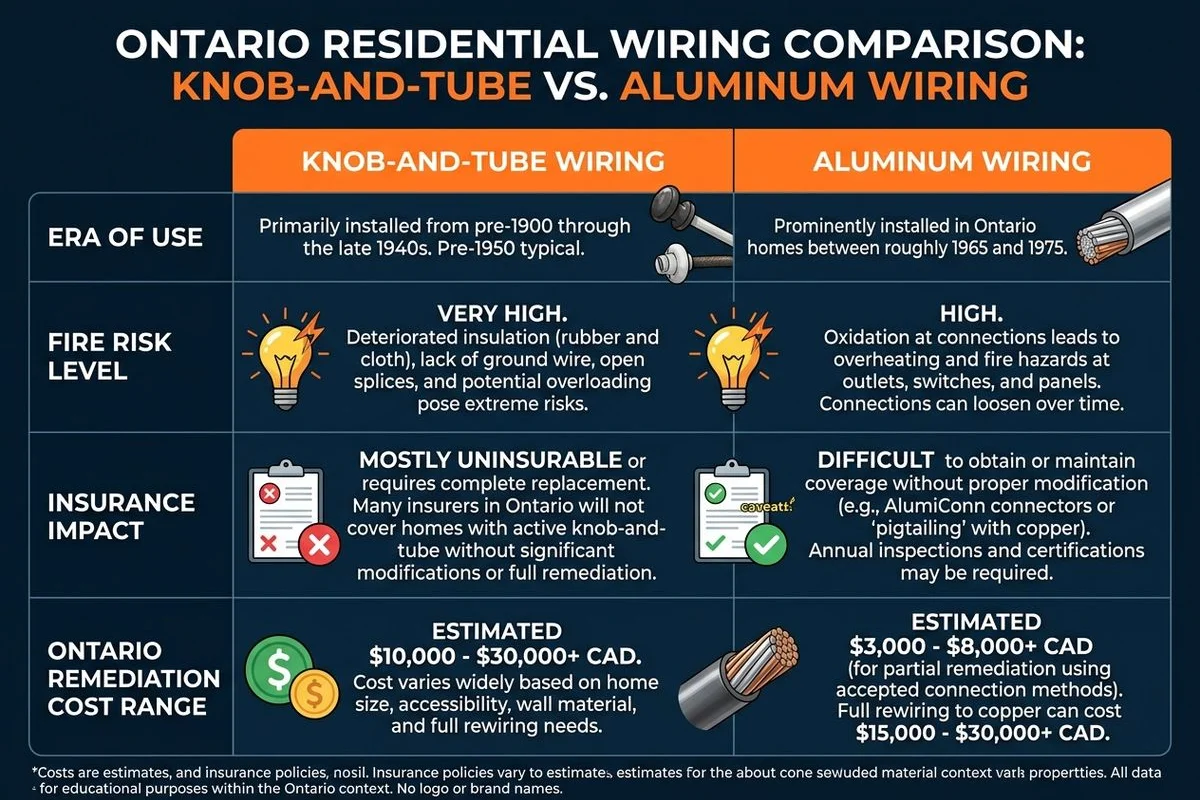
We see this scenario constantly with older properties across the GTA. Buyers find a great house, but the home inspection flags multiple legacy electrical systems.
These setups trigger immediate red flags for Ontario insurance carriers like TD and Desjardins.
The risk profiles for each system are actually very different. Let us break down the exact knob and tube vs aluminum wiring safety risks and explain how insurance companies treat them. You will then see practical remediation steps to keep your project on track.
What This Guide Covers
Quick overview of the points worth knowing before you book any work:
1. Side-by-side hazard profile (era, failure mode, fire risk)
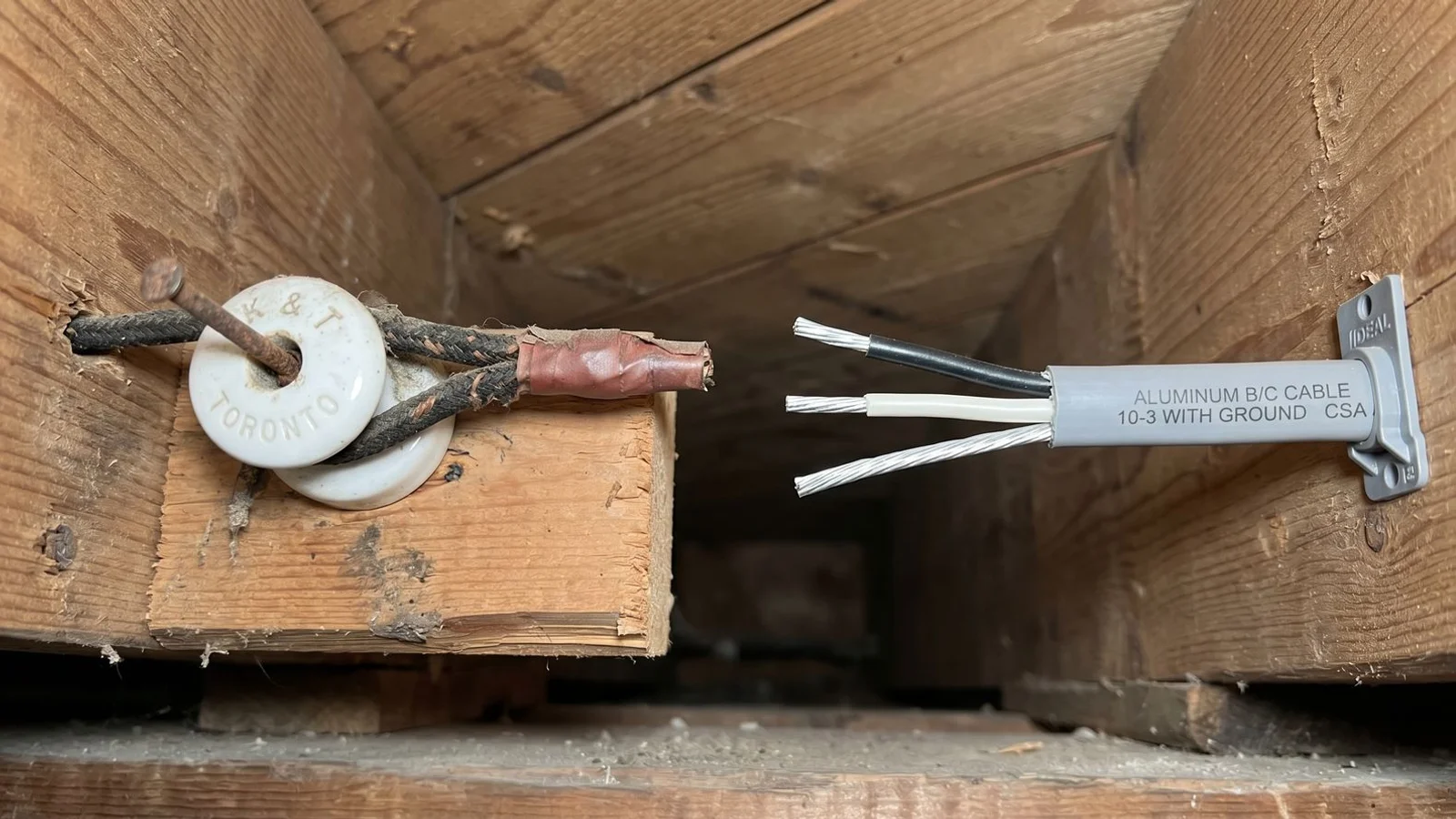
Knob and tube wiring presents a severe fire hazard due to degrading insulation and a lack of grounding, while aluminum wiring primarily risks arcing at connection points. The older the home, the greater the concern.
Our Toronto electrical contractor team regularly replaces both systems. K&T was the standard from the 1880s through the 1940s.
Modern attic insulation traps the heat that the original open-air design needed to dissipate. This trapped heat bakes the rubber sheathing until it crumbles away.
The resulting exposed live wires create a direct fire hazard. Another major issue is that these circuits were designed for 60-watt light bulbs, not space heaters or modern appliances. Overloading these old ungrounded lines is dangerously easy.
| Feature | Knob and Tube (K&T) | Aluminum Wiring |
|---|---|---|
| Installation Era | 1880s to 1940s | 1965 to late 1970s |
| Primary Failure Mode | Brittle insulation, lack of ground | Loose connections, oxidation |
| Fire Risk Source | Overheating in insulated walls | Arcing at switches and outlets |
Aluminum branch wiring became popular later, mostly between 1965 and the late 1970s. The metal itself expands and contracts significantly more than copper as electricity flows through it.
This constant movement loosens the connections at switches and receptacles over time. Loose connections lead to oxidation and dangerous arcing.
We find scorched outlets and melted plastic cover plates during almost every aluminum inspection.
2. Insurer treatment differences (K&T worse, aluminum more nuanced)
Insurance companies view active K&T as a critical risk and will almost universally demand full removal. Aluminum setups offer more flexibility if a licensed electrician performs approved safety upgrades.
Most Ontario insurers refuse to renew policies on homes with active K&T circuits. Companies like Intact or Square One might give buyers a strict 30 to 60-day grace period to remove it completely. Homes with more than 10 percent of this old wiring face immediate coverage denials.
Our crews see policy cancellations happen frequently. The lack of a grounding wire means the system cannot safely discharge faults. Insurers simply refuse to take on that level of liability.
- The 10 Percent Threshold: Homes with more than 10 percent K&T face immediate coverage denials.
- Short Grace Periods: Carriers may grant a 30-day window to complete the removal after closing.
- Certificate Requirements: ESA Certificates of Acceptance are mandatory for policy renewals.
Aluminum systems face strict scrutiny but are rarely an automatic denial. The Electrical Safety Authority (ESA) permits this material if the terminations are properly secured. Insurers typically want proof that a Licensed Electrical Contractor (LEC) has inspected and repaired every connection.
You will need an official ESA Certificate of Acceptance to satisfy your broker. The approved fix involves adding copper pigtails to the ends of the aluminum lines. This stops the oxidation cycle and secures the connection to modern devices.
3. Remediation cost differences
Removing K&T requires a complete, expensive home rewire, while aluminum issues can often be solved with more affordable connection repairs. A full replacement is always the safest route, but budgets dictate the path forward.
Replacing an entire knob and tube system is a major renovation. A complete removal in a typical Toronto home runs between $8,000 and $25,000 CAD. The total depends heavily on the square footage and how easily electricians can access the wall cavities.
Many of these 100-year-old properties also still rely on outdated 60-amp electrical panels. You must upgrade to a modern 100-amp or 200-amp service panel to meet current building codes. A standard panel upgrade adds roughly $1,400 to $3,000 to the total bill.
- Home Size: Rewiring generally costs $10 to $22 per square foot in Ontario.
- Wall Access: Finished walls require cutting access holes and paying for subsequent drywall repairs.
- Number of Circuits: Modern living requires 20 to 40 circuits, up from the original 4 to 6.
- Permits: ESA inspections and permits add $200 to $600 to the final invoice.
We strongly recommend getting a flat-rate quote in writing before any work starts. Hourly plus materials quotes often drift higher as contractors find surprises behind plaster walls. A fixed price protects your renovation budget.
Fixing aluminum is far less invasive if the wire remains in good condition. Pigtailing every outlet and switch in an average home costs between $1,500 and $4,000. Full rewiring is always an option, but pigtailing with approved Al/Cu connectors keeps costs manageable.
4. What to do if a Toronto home has both
Tackle the K&T wiring first because it poses the highest immediate fire risk and presents the biggest obstacle for securing property insurance. You can then address the aluminum connections under the same electrical permit.
Finding both systems in a single house usually means previous owners did partial upgrades over the decades. The original 1920s core might still run on ceramic knobs, while a 1970s addition uses silver-coloured conductors. This layered approach creates a complex diagnostic challenge.
Our technicians always map the entire circuit layout before pulling any permits. Specifics depend on the home vintage, wall finish, and existing service capacity. A thorough assessment prevents costly surprises once the walls are open.
“Combining the removal of knob and tube with the pigtailing of aluminum under a single Electrical Safety Authority permit saves homeowners significant money on inspection fees.”
You must completely disconnect and remove the older cloth-covered lines. Electricians can easily pigtail the newer branch circuits while the main power is off.
5. Priority decision when budget is constrained
Eliminate the ungrounded knob and tube circuits immediately to secure your insurance policy. Budget for the aluminum repairs in a second phase if necessary.
Financial constraints force tough choices during major home renovations. If you cannot afford a complete whole-house rewire right away, safety must dictate the schedule. The century-old rubber insulation is actively failing inside your walls right now.
Insurance companies will force your hand on the older system regardless of your budget. You cannot live in an uninsured home, so the $10,000 to $25,000 removal cost becomes unavoidable. Secure a fixed price from a reputable contractor to stop the financial bleeding.
- Phase One: Extract all ungrounded K&T to secure the insurance policy and eliminate immediate fire risks.
- Phase Two: Upgrade the main electrical panel to 100 or 200 amps to meet modern code requirements.
- Phase Three: Pigtail the 1970s aluminum connections to stabilize the remaining legacy circuits.
We help homeowners stage these upgrades to manage cash flow. The ESA-approved pigtail method for the newer 1970s wire acts as a reliable medium-term fix. This strategic approach secures the house against the worst fire risks while keeping the initial project costs lower.
Ready for a Quote?
If you are ready to scope this work, our team is available to discuss your specific needs. Getting a professional older home wiring comparison and assessment is the smartest way to understand your exact upgrade costs.
We handle free estimates on residential projects across the CA region. Every job comes with flat-rate quoting, ESA permits registered in our Licensed Electrical Contractor name, and a guaranteed Certificate of Acceptance.
A proper site walk takes the guesswork out of the final price. When assessing aluminum vs knob tube, knowing the numbers matters. Visit knob and tube wiring replacement for the full scope of what we do. You can also contact us directly to schedule a walkthrough and resolve any k&t vs aluminum insurance compliance issues.
For more context on related decisions, read our guide on knob and Tube Replacement Cost in Ontario (2026).
Frequently Asked Questions
Which one will an insurer flag harder?
+
Active K&T. Most insurers refuse renewal; aluminum often allows pigtailing as compliance. For Toronto homes specifically, we handle this through our LEC with the ESA permit included in the flat-rate quote. Free estimates on residential projects.
If a home has both, which to fix first?
+
K&T first if budget is constrained; aluminum can be pigtailed as a phase-2 fix. For Toronto homes specifically, we handle this through our LEC with the ESA permit included in the flat-rate quote. Free estimates on residential projects.
Is one more dangerous than the other?
+
Both are real risks. K&T fails from insulation degradation, aluminum from termination expansion. For Toronto homes specifically, we handle this through our LEC with the ESA permit included in the flat-rate quote. Free estimates on residential projects.