What Is Knob and Tube Wiring?
Porcelain knobs and tubes explained, era of installation, ungrounded circuits, cloth-covered insulation, and why it was replaced.
By Michael Chen, Licensed Master Electrician ·
You often hear contractors throw around technical terms during a renovation, but a few specific phrases should immediately grab your attention.
What is knob and tube wiring, exactly? It is a century-old electrical method that powers many older homes but fails to meet the strict safety standards of 2026.
We will clearly outline how this outdated system functions. Expect a direct breakdown of the risks, the materials involved, and exactly what an upgrade entails.
What Is Knob and Tube Wiring?
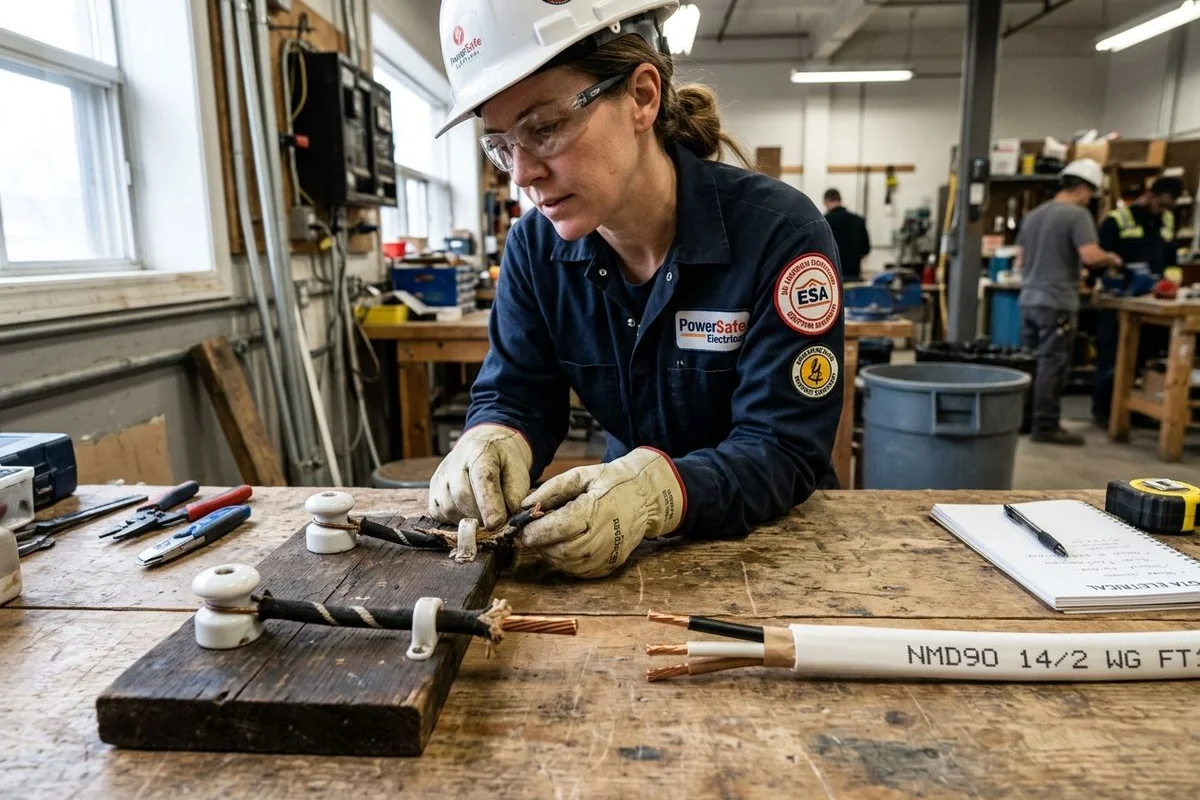
What is knob and tube wiring in simple terms? It is an early standardized electrical system that separates the hot and neutral wires by stringing them through open air, using ceramic fittings to anchor them to the wood framing.
Our team sees this setup frequently in older Toronto homes. The system relies entirely on open space to dissipate heat, meaning it becomes highly dangerous when buried under modern energy-efficient attic materials.
What This Guide Covers
Here is a quick overview of the essential details worth knowing before you book any electrical work. We find that informed property owners make the safest and most cost-effective decisions.
1. Porcelain knobs (insulators) and tubes (joist passes) explained
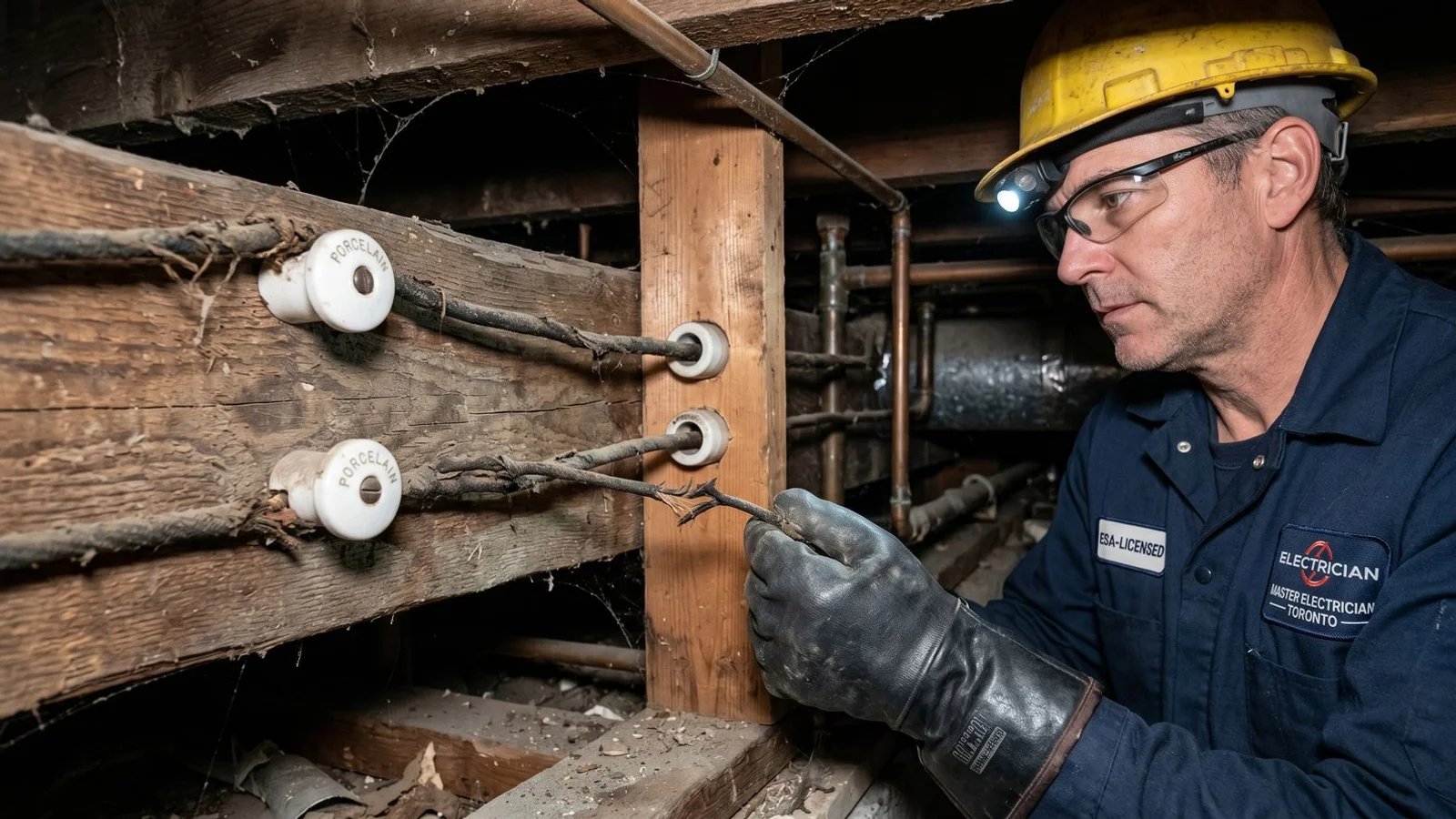
Porcelain knobs are the ceramic anchors that hold the wires tightly in place, while tubes are protective ceramic sleeves that allow wires to pass safely through wooden joists. This physical separation from the combustible wood was the primary safety mechanism against fires.
Our electricians note that the Ontario Electrical Safety Code (OESC) outlines specific rules for these historical setups. The wire was strung tightly between knobs usually spaced about 4.5 feet apart along the joist.
“Covering active K&T wiring with thermal insulation is a strict violation of the Ontario Electrical Safety Code, creating an immediate and severe fire hazard.”
Modern blown-in insulation traps the heat that this open-air design needed to dissipate safely. Most Ontario insurers refuse to renew policies on active properties for this specific reason. Full removal in a typical Toronto home runs between $8,000 and $25,000 CAD today, depending heavily on square footage, wall access, and the size of the necessary electrical panel upgrade.
2. Era of installation (roughly 1900-1950 in Toronto)
This system was the primary method for wiring residential properties from the 1880s through the late 1940s. Canadian builders officially phased it out of new construction by the early 1950s.
We frequently handle removals of pre-1950 home wiring in historic neighbourhoods across the GTA, including The Annex, High Park, Cabbagetown, and Riverdale. The original engineers designed these power grids for very light electrical loads, like a few incandescent bulbs and an AM radio.
Today, a single kitchen air fryer or modern space heater can draw more power than an entire 1920s household. This causes the aging system to fail against modern demands:
- Designed for low 15-amp total house loads
- Cannot safely support electric vehicle (EV) chargers
- Fails under the heavy demand of modern HVAC systems
- Lacks the dedicated circuits required for multi-appliance kitchens
3. Ungrounded circuits (two-prong outlets)
An ungrounded circuit lacks the essential third wire, known as the equipment ground, leaving excess electrical current with nowhere safe to go during a power surge. This specific setup powers the older two-prong outlets found in vintage properties.
Our technicians emphasize that this poses a severe shock risk, particularly in wet environments like bathrooms or kitchens. The lack of a ground wire also leaves sensitive modern electronics, such as smart TVs and computers, highly vulnerable to permanent short-circuit damage.
Upgrading a two-prong outlet to a modern three-prong version without adding a true copper ground wire violates code and creates a dangerous false sense of security. If you must use an existing ungrounded circuit, the OESC requires the installation of Ground Fault Circuit Interrupter (GFCI) protection, though a complete house rewire remains the safest permanent fix.
4. Cloth-covered insulation degradation
The original setup relied heavily on cloth wiring insulation to protect the live copper conductor. This organic material slowly deteriorates, becoming dangerously brittle after decades of attic temperature fluctuations.
Our inspections routinely uncover bare, exposed wires inside ceiling fixtures and switch boxes. The intense heat from old incandescent bulbs bakes the rubber inner-insulation until it simply cracks and flakes off when touched.
You face additional hidden risks behind the plaster walls. Visual inspections frequently reveal these common damage points:
- Brittle Rubber: Crumbles away near light fixtures and heavy-use outlets.
- Chewed Cables: Rodents target the sweet-tasting cotton casing in attics and crawlspaces.
- Amateur Splices: Decades of hidden DIY fixes wrapped loosely in drying electrical tape.
5. Why Loomex (NMD90) replaced it
Loomex, technically known as NMD90 (Non-Metallic Dry), is a modern plastic-sheathed cable that bundles the hot, neutral, and bare copper ground wires together inside a tough PVC jacket. This consolidated design replaced the old system because it is vastly safer, handles much higher temperatures (up to 90°C), and requires less labor to run through modern construction.
We upgrade properties to NMD90 because it instantly resolves the insurance denial issues associated with older setups. The tough thermoplastic insulation safely tolerates being buried beneath deep attic insulation or packed inside tight wall cavities without overheating.
| Feature | Knob & Tube | Loomex (NMD90) |
|---|---|---|
| Grounding | None (2 wires) | Dedicated Bare Ground Wire |
| Insulation Material | Rubber & Cotton Cloth | PVC Thermoplastic |
| Heat Tolerance | Requires Open Air | Safe in Insulation (Up to 90°C) |
| Insurance Status | Often Denied or Penalized | Universally Accepted |
Ready for a Quote?
Are you ready to address the aging electrical system in your property?
Our licensed team is available to discuss your specific needs. We provide free estimates on residential projects across the GTA.
The pricing is straightforward with a flat-rate quote, and the process always concludes with an official Certificate of Acceptance.
Our company secures all necessary ESA permits strictly under our Licensed Electrical Contractor name.
Visit knob and tube wiring replacement for the full scope of what we do, or contact us directly to book an assessment.
For more context on related decisions, read our guide on living Through a Whole-Home Rewiring: What to Expect.
Frequently Asked Questions
Is all knob-and-tube dangerous?
+
Not by itself. Well-maintained K&T can last decades; the risk is degraded insulation, overloading, and combination with insulation that traps heat. For Toronto homes specifically, we handle this through our LEC with the ESA permit included in the flat-rate quote. Free estimates on residential projects.
When was K&T phased out in Ontario?
+
Largely replaced by the early 1950s, though installs continued in some renovations into the late 1950s. For Toronto homes specifically, we handle this through our LEC with the ESA permit included in the flat-rate quote. Free estimates on residential projects.
Why is K&T ungrounded?
+
It predates the residential grounding requirement. Only hot and neutral, no equipment ground. For Toronto homes specifically, we handle this through our LEC with the ESA permit included in the flat-rate quote. Free estimates on residential projects.